

New England is chock full of fascinating people, places, and things. But what made (and makes) the South Coast what it is today and why do we all cherish this area? We’ll try our best to answer that for you in the following pages, in alphabetical order. (This originally appeared in our Early Summer 2025 issue.)
Art
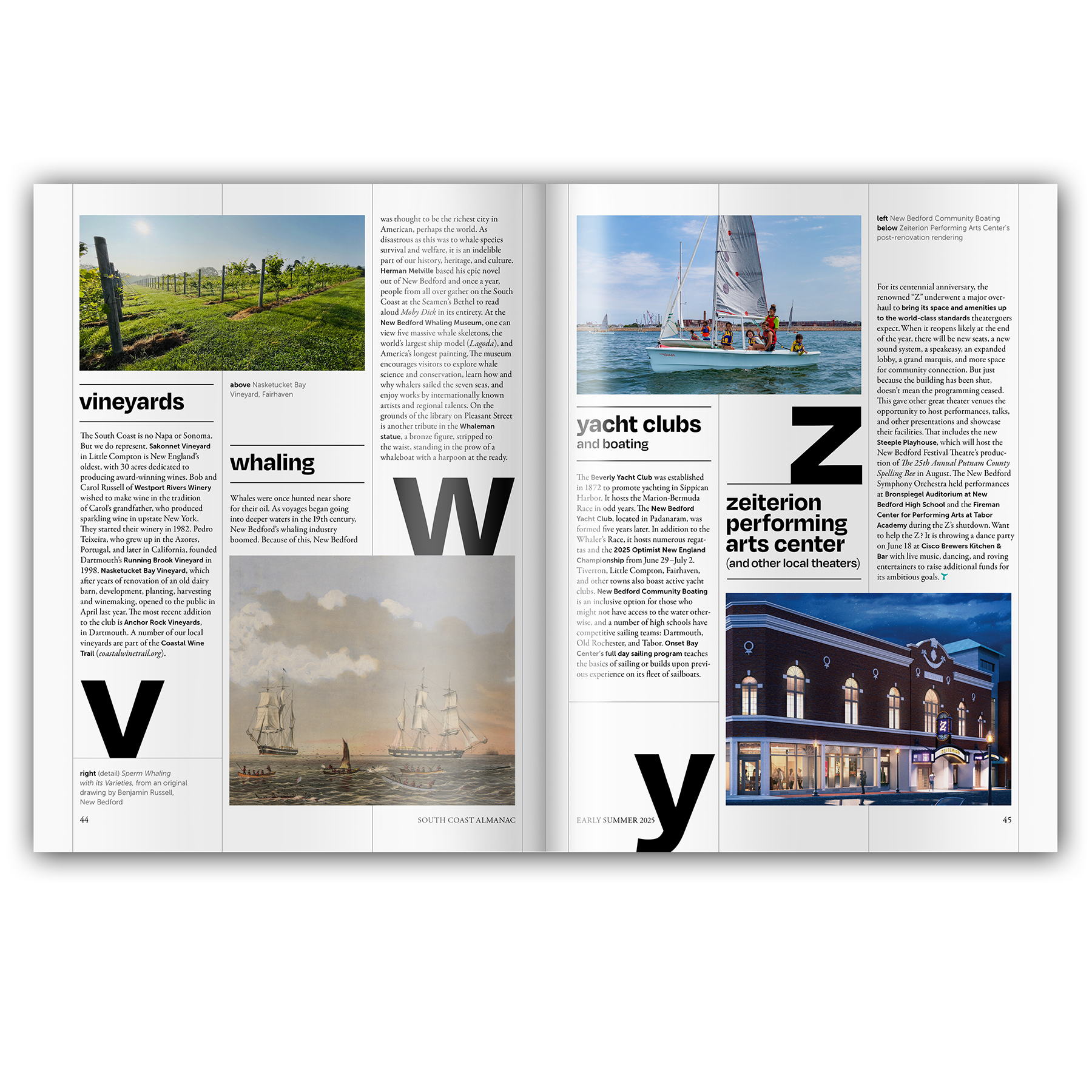
The South Coast community vibe epitomizes contrast, from the urban grit of cities New Bedford and Fall River to the coastal calm/charm of the quiet exurbs surrounding them. The local art mirrors that: city culture produces envelope-pushing contemporary art, while others take inspiration from the land and produce a perhaps more traditional beauty across a wide swath of media. Then, of course, there are those who defy any stylistic boundaries. And there is lots of it, given that our cost of living is more amenable to professionals starting out and we have so many organizations that support local art and artists: AHA!, New Bedford Art Museum, DATMA, Co+ Creative Center, Gallery X, Soco Art Labs, Fall River Arts and Culture Coalition, Greater Fall River Art Association, Marion Art Center, the Art Drive and/or the South Coast Artists (which host studio tours every summer), just to name a few.
Bridges, Boardwalks, and Barriers
In communities by the sea, you are bound to find numerous structures that allow us to travel over water or protect us from it when Mother Nature rages. The Charles M. Braga Memorial Bridge in Fall River measures 101 feet wide and more than a mile long (5,780 feet to be exact). It was supposed to be called the “Somerset-Fall River Bridge,” but officials decided to name it after a Fall River native of Portuguese descent who was killed in the attack on Pearl Harbor. The New Bedford-Fairhaven Bridge is a swing truss bridge actually made of three bridges where Route 6 crosses the Acushnet River. The swing span still opens on a regular daily basis, although MassDOT has considered upgrading it to a vertical lift bridge. Another moving bridge is the Padanaram Bridge, a historic causeway across Apponagansett/Padanaram Harbor. Mariners may request a bridge opening by hailing the bridge tender on short wave radio Channel 13. A new 70-foot-tall MBTA Pedestrian Bridge stretches across the Route 18 highway in New Bedford to connect Purchase Street with the new MBTA station. The bridge is part of the long-delayed South Coast Rail project. Arches attach to thin cables that hold up the walkway and create visual drama. The Cape Cod Canal Railroad Bridge is a vertical lift bridge in Bourne that carries railroad traffic across the Cape Cod Canal. The bridge was constructed beginning in 1933 by the Public Works Administration for the United States Army Corps of Engineers, which operates both the bridge and the canal. The bridge has a 544-foot main span, with a 135-foot clearance when raised, uses 1,100-short-ton counterweights on each end. At the time of its completion, it was the longest vertical lift span in the world. If you are into visiting New England’s famed covered bridges, there is actually one in Freetown off Old Slab Bridge just northwest of the center of town. Categorized as a stringer, it uses parallel steel beams instead of traditional trusses for structural support. Though historical in appearance, it was built fairly recently: 1979. The new “Shining Tides Mile” boardwalk on the Mattapoisett Rail Trail is a steel structure (to withstand hurricane force winds) with traditional wood detailing. It was designed to be high enough to meet flood surge heights and allow enough sunlight for the aquatic life below; its eloquent curvature is a site to behold. The hurricane barrier, surrounding the land and extending across the harbor, measures nearly 15,000 feet long. Construction of the Barrier began in October 1962 and was completed in January 1966, costing $18.6 million.
Cranberries
Southeastern Massachusetts is the birthplace of the commercial cranberry industry, which supports nearly 6,400 jobs and contributes an economic impact of $1.7 billion annually. The South Coast towns of Acushnet, Carver, Middleborough, Rochester, and Wareham host a majority of these working farms. A.D. Makepeace Co. was founded in 1854. Some of its oldest cranberry bogs date back to 1878. Abel D. Makepeace established hundreds of acres of bog across southeastern Massachusetts and became known as the “Cranberry King.” Today, the company farms 1,750 acres of bogs across the South Coast and Plymouth. A.D. Makepeace is the largest grower-owner and a founding member of the Ocean Spray growers’ cooperative, the internationally known brand name in cranberries. It is one of the largest private landowners in Massachusetts, with around 14,000 acres, including those bogs, surrounding properties, and more. There are many other smaller farms as well, all of which make Massachusetts the second-highest cranberry producing state (Wisconsin is first). But cranberry production is not growing. And many companies are retiring their weakest yielding bogs. Decas, Slocum-Gibbs, and other, much smaller farmers have partnered with the Buzzards Bay Coalition to restore some of their bogs to their original wetland state for the good of the watershed and wild ecosystem.
Douglass, Frederick and Anna
Arriving in New Bedford in 1938 via the Underground Railroad, Anna Murray and Frederick Bailey found refuge in a home right across the street from the park that now bears the younger man’s likeness in a statue. They were welcomed by African-American abolitionists Nathan and Polly Johnson, who encouraged them to adopt the surname Douglass. Frederick would earn his first wages and start a family in New Bedford, before becoming an internationally renowned orator and abolitionist himself. In 1839, Frederick and Anna Douglass moved to 157 Elm Street, their first home located in an African-American neighborhood in the city’s West End. They moved to larger quarters in the northern end of town on Acushnet Avenue, which was located near the wharves where Frederick often worked while Anna raised the family. Three of Douglass’ five children were born in New Bedford before the Douglass family moved to Lynn, Massachusetts, in 1942.
Excursions
Given the reintroduction of the MBTA to New Bedford and Fall River, our extensive ferry system, and the destinations you can visit from New Bedford airport, our area is a hub for short trips to some remarkable places. We are now a convenient quick train ride to all that the city of Boston offers. Take the Seastreak Ferry directly from New Bedford to Martha’s Vineyard or Nantucket (seasonally between May and October) or the Cuttyhunk Ferry Service or Water Taxi to Cuttyhunk Island. Cape Air goes to Martha’s Vineyard and Nantucket as well.
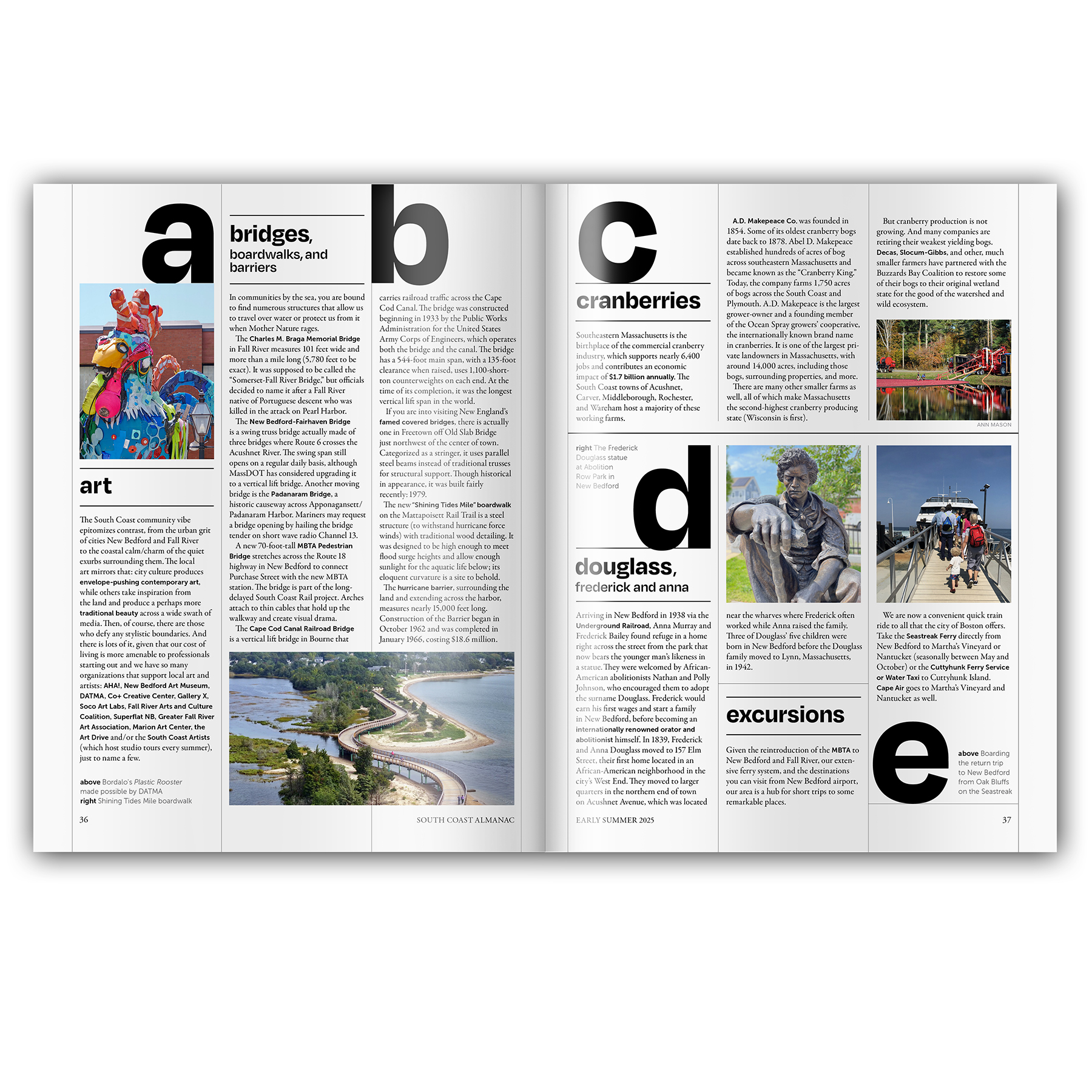
Farm coast
With their rolling hills, stone walls, and rich farmland leading to a picturesque shoreline, the towns of Tiverton, Little Compton, Westport, and Dartmouth are collectively known as the Farm Coast. Coastal historic farmsteads are generally rare as much of the land has been developed into vacation/retirement housing or summer resorts in the modern era. Many of the original elements, including homes, barns, and wells may survive as either standing structures or below-ground features within parcels that have been maintained throughout the years. There is a thriving culinary, recreational, and artistic culture in these towns on account of these rural qualities, and people are committed to the preservation of this distinctive heritage.
Golf
In the waning days of a very wealthy whaling industry, golf arrived in New Bedford. William Campbell, a Boston professional golfer, designed New Bedford’s first golf course on the Hawthorn farm. It was a short, flat nine-hole links design. The Hawthorn Club was officially incorporated in 1898. Two years later, several board members, prominent businessmen from the emerging industrialized economy, began searching for another venue to accommodate the growing membership. In 1902 approximately eighty-six acres of land was located in nearby Dartmouth, Massachusetts. The site selected was another working farm which had recently been sold to a group of investors hoping to establish a trotter racetrack on the site. When that deal fell through, the Hawthorn Club’s original incorporators swept in and secured the property. The Country Club of New Bedford was opened in 1902 and expanded to 18 holes in 1923. It is part of a trio of courses all within a few miles of each other, including Allendale Country Club and Whaling City Golf Course. According to Golf Digest, with the discovery of some original blueprints, the ocean-side, links-like Kittansett Club in Marion, long thought to be the product of an amateur architect, Frederic Hood, was actually the work of well-known course architect William Flynn. The Club was named by the magazine as the 5th best course in Massachusetts in 2023. Other great courses in the area include Bay Pointe and Little Harbor in Wareham, Reservation Club and Bay Club in Mattapoisett, Marion Golf Club, Acoaxet in Westport, Sakonnet Golf Course in Little Compton, and a number of courses in the inland towns of Acushnet, Rochester, and Lakeville. But the South Coast’s most prominent connection to golf is the Acushnet Companies, parent to international brands Titleist and FootJoy. The rubber company’s foray into making golf balls came to be after a golf game at the New Bedford Country Club where founder Phil Young and his partner, the head of the x-ray department at St. Luke’s Hospital, played an uncharacteristically bad round. Young convinced his partner to x-ray the balls, and once he revealed the balls were cockeyed, Young committed his company to making better golf balls and Titleist was born. Acushnet Companies made a deal to buy a golf club and bag manufacturer called Golfcraft with plants in California and New Jersey. They would go on to buy FootJoy from General Mills in 1983.
History
New England is bullish on preserving its history, and the South Coast is no exception. There exist a number of strong historical societies in most of our towns. Westport Historical Society recently presented a Women of Westport Point project and exhibit. New Bedford Historical Society has done an amazing job detailing the local influence on the Underground Railroad (see D and J). Little Compton Historical Society’s new permanent exhibit, titled “Everyone Was a Farmer,” complemented by a half-hour documentary called Rooted in Tradition: 21st Century Farming in Little Compton, is spot-on for the rural community. Fall River Historical Society maintains the world’s largest collection of Lizzie Borden artifacts.
Ice Cream
Acushnet Creamery has been owned and operated by Doug and Donna Coray in Acushnet for more than 20 years. They now have a popular New Bedford Harbor location at Pier 3. In Apponagansett Park, the present-day Gulf Hill Dairy Ice Cream is widely recognized for its food stand which is shaped like a bucket. Across the Padanaram Bridge is the popular Dockside Ice Cream. If you are a soft serve fan, head to Betty Ann’s Dairy Freeze in the village of Buzzards Bay. On the recent Mattapoisett Tour de Crème riders sample frozen treats from Captain Bonney’s Creamery and Robin’s Nest in Rochester, West Island Creamery and McGraw’s Back Porch Ice Cream in Fairhaven, Seaport Slip in Mattapoisett, and Country Whip in Acushnet.
Johnson, Nathan and Polly
Nathan Johnson (1797-1880) and Mary “Polly” Durfee Johnson (1784-1871) owned a popular confectionery and catering business in the 1800s. The African-American couple were also renowned abolitionists, and their home at 21 Seventh Street in New Bedford became the first safe house of Frederick and Anna Douglass in 1838. Now the headquarters of the New Bedford Historical Society, the Nathan and Polly Johnson House has been recognized as a National Historic Landmark and is a site on the New Bedford Whaling National Historical Park’s Underground Railroad Tour. Local filmmaker Alyssa Botelho recently debuted her short film on the Johnsons titled Sweet Freedom.
King Richard’s Faire
Minstrels. Acrobats. Fire eaters. Sword swallowers. Aerialists. Larger-than-life-size puppets. Jousting knights. New England’s largest Renaissance festival, which runs weekends in the fall features eight performance stages, food and spirits, flamboyant medieval dress, and all forms of debauchery one can imagine. It recently announced that it will be moving from its longtime site in Carver to Edaville Railroad’s grounds. (Edaville is an icon in this area, but given its recent ownership change, we’ll have to wait and see how it manages its rebirth.)
Lighthouses
Built in 1898 by the United States Lighthouse Board, Butler Flats Light is a sparkplug lighthouse located in the outer harbor at the mouth of the Acushnet River. It is the only known caisson lighthouse designed by a marine architect. Sakonnet Light was deactivated in 1954 after Hurricane Carol and was going to be destroyed, but local citizens protested. After being listed on the National Register of Historic Places in 1983, it was reactivated by the United States Coast Guard in 1997. The Friends of Sakonnet Lighthouse completed a $1.45 million restoration of the lighthouse in 2012. Ned’s Point Lighthouse, a beautifully picturesque 39-foot stone lighthouse, was built in 1838 and is now a great place for a picnic at the Veterans of Mattapoisett Memorial Park. Wanna stay overnight in one? Book the Borden Flats Lighthouse in Fall River… for 2026 (this year is 95% booked).
Marine Animal Rescue
The unique geography of Cape Cod makes Southern Massachusetts shores an unfortunate destination for marine animal strandings and injury. The New England Aquarium and the International Fund for Animal Welfare (IFAW) have responded to many dolphins, seals, and turtles over the years. In May 2021, attempts were made to herd a pilot whale out of a shallow cove off New Bedford. Eventually the whale stranded, and IFAW, which led the response, determined euthanasia to be the most humane option. Thankfully, many smaller animals find their way to be rehabilitated by the National Marine Life Center in Buzzards Bay. Founded in 1995, NMLC is an independent, non-profit that “rehabilitates and releases stranded marine mammals and sea turtles in order to advance science and education in marine wildlife health and conservation.”
Narrows Center for the Arts (and Other Music Venues)
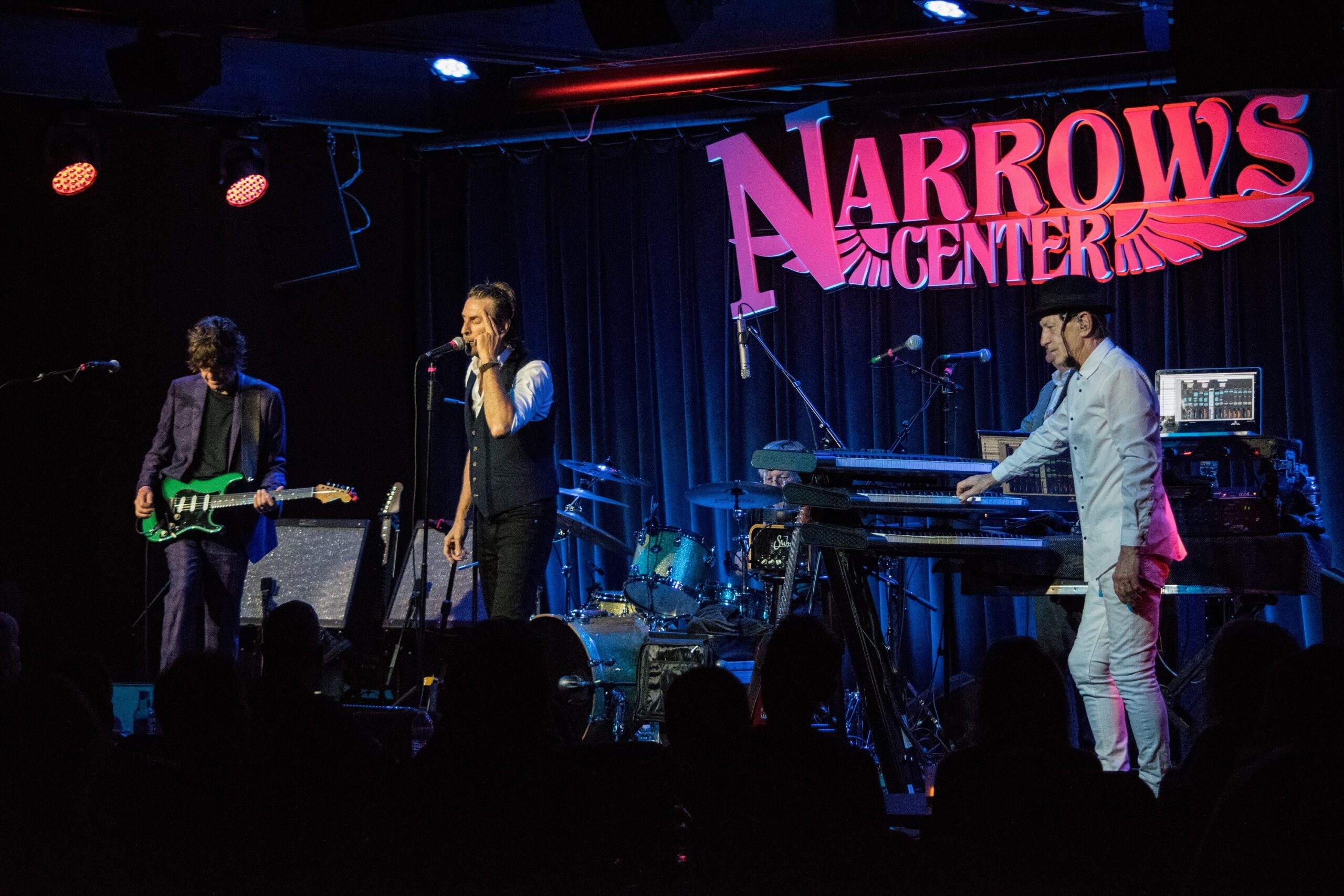
On the third floor of this historic mill building is one of the most ideal venues—for both audio and visual purposes—for performing arts with an intimate 430-seat performance area. Despite its seating capacity, it has attracted the likes of Peter Wolf, Joan Osborne, and Los Lobos in the past year. In 2017, the center purchased the building and tripled the area in which they present music and art, and house artists’ studios, classroom instruction, and arts-related businesses. The Vault in New Bedford has become one of the premier places in New England for live music, hosting bands of a golden age of rock, the tribute bands who cover them, and up-and-coming acts. Acoustic entertainment in the 1883 Lounge at the Glen Cove Hotel in Onset every Thursday is great for local acts.
Outdoors
Whether you are into competition, recreation, or simply exploration, the South Coast has something for everyone. Kayak our waters, hike our public trails. If you are a cyclist, you have very scenic bike rides in which you can participate: the Narragansett Bay Wheelmen put on long-distance rides throughout the summer and the Buzzards Bay Watershed Ride, which goes 100 miles from Sakonnet Point to Woods Hole, raises money for the Buzzards Bay Coalition. If beaching it is your thing, we’ve got that in spades. There are too many to list here, although the two state park beaches—Horseneck and Demarest Lloyd—are spectacular. We might be a bit partial to Onset Beach and all of the amenities from the Onset Bay Center right there.
Portuguese Heritage
According to the Library of Congress, at the beginning of the twentieth century, New Bedford had the largest Portuguese population/diaspora outside of Portugal and its islands, counting 7,300 first-generation Portuguese and 4,600 Americans born of Portuguese parentage. A majority of New Bedford’s Portuguese immigrants came from the Azores and the Madeira Islands. That heritage is celebrated in the popular Madeiran feasts throughout the area and the Azorean whaleboating tradition. A little known fact: Fall River’s population now has a larger percentage of Portuguese ancestry than New Bedford’s.
Queer Pride
We are very excited for “Being Seen: Celebrating SouthCoast Pride,” a new public art installation, in which Liz Collins and DATMA will be creating a public art piece with UMass Dartmouth CVPA students, set to premier this month. As artists-in-residence at the New Bedford Whaling National Historical Park, Beatrice and Elaine Alder explored the city’s queer and working-class histories through Law of Salvage: Queer Stories of the South Coast. Through archival research and oral histories, they created a multidisciplinary exhibit that combined art and prose. The Alders used ceramics, textiles, and prints to reclaim stories of overlooked queer laborers and disrupt traditional binaries, bringing these untold narratives to life. We’re also fans of the NB Gallery Bar—owned by Almanac contributing photographer Jes Fritze, which is a safe community space for LGBTQ people and art we can all appreciate. Shout out to South Coast LQBTQ Network, which hosts Pride South Coast 2025 held on subsequent Saturdays in June in New Bedford and Taunton, respectively.
Rogers, Henry Huttleston
Fairhaven has so many beautiful landmarks thanks to Henry Huttleston Rogers. Rogers School, a former elementary school building, was his first gift to the Town of Fairhaven. The town’s Italian Renaissance-style library is named for his daughter Millicent, who died at the age of 17. Gifts include Town Hall, George H. Taber Masonic Lodge Building, Washington Street School, Unitarian Memorial Church, Tabitha Inn/Our Lady’s Haven, Fairhaven High School, and Cushman Park. Want a tour of Rogers’ achievements? The Fairhaven Office of Tourism hosts Tales of an Old Seaport Village on Tuesday mornings at 10 am, June through August.
Seafood
Thanks to the success of the whaling era, New Bedford transitioned to become one of the largest commercial fishing ports in the country. In 2001, it was ranked #1 in overall haul value and has been the top-ranked port by that measure ever since, due in part to the value of sea scallops, which account for 84% of the value of all landings here. The chef, restaurants, and purveyors at the New Bedford’s Fishing Heritage Center’s annual Seafood Soiree are a who’s who of great seafood in the area: 222 Union, Merrill’s on the Waterfront, Raw Seafoods Inc., Restaurante Algarve, Costa’s Kitchen, The South Coast Sicilian, Hanami Tea Kitchen, Cisco Brewers New Bedford, Lobster Trap Restaurant & Fish Market, West Island Oysters, Foley Fish, Turk’s Seafood, Olivia’s, Cast Seaside Bar & Bites, Atlantic Red Crab Company, and North Coast Seafoods. We are also big fans of Kylers, Bayside Restaurant, Black Whale, Blue Point, Qhahog Republic, Westport Sea Farms, and The Back Eddy, all of whom regularly fare well in our Best Of issue’s seafood categories.
Thrift
Circa has been serving up vintage finds on the South Coast for nearly 40 years. Hewn, and MadLila are also in New Bedford. In Fairhaven, you have Seconds Count; in Swansea, the Pink Bag. It is not all clothing. When New England’s movie production industry was having a hey day, New Bedford Antiques at the Cove was helping shows and films “find just the right pieces for their productions’ set design.” Other great antique stores in the region include Acushnet River Antiques and Marion Antique Shop.
Universities and Colleges
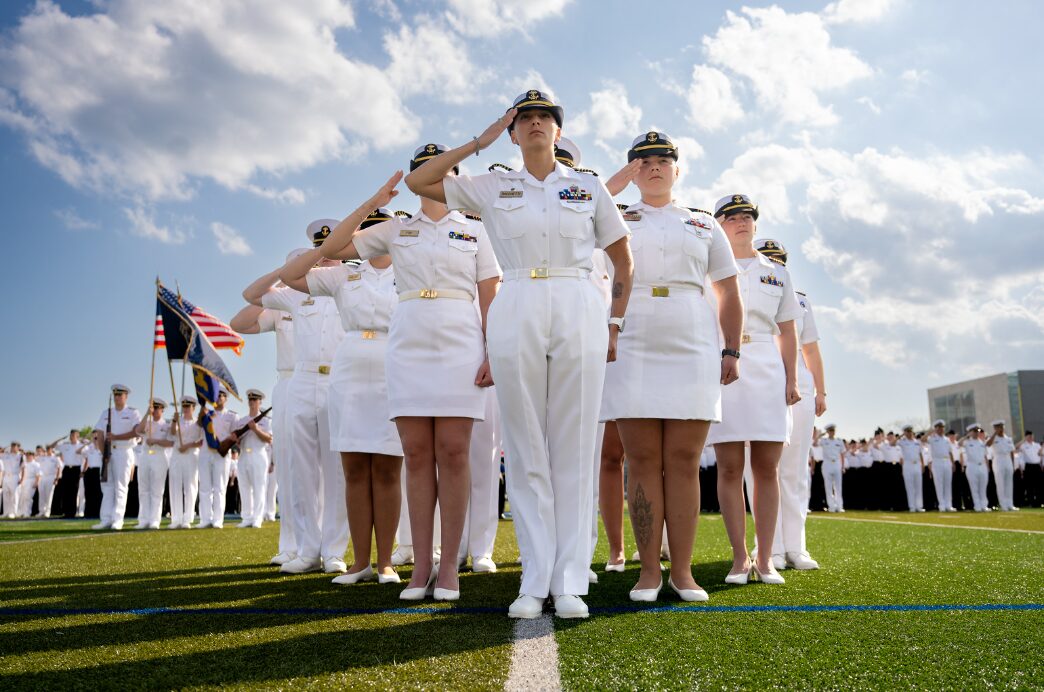
The South Coast is fortunate enough to house three special institutions of higher education. UMass Dartmouth is known for its law school, Charlton Business School, and the School for Marine Science and Technology, which tackles “today’s most pressing oceanographic challenges.” The prestigious Swain School of Design merged with its College of Visual and Performing Arts many years ago, and many creatives find their niche here. Notable professors include Erin Bromage (Biology), who during the onset of the COVID-19 pandemic, gained international fame when he penned a blog, “The Risks – Know Them – Avoid Them,” to understand the ways that the virus can spread through a community, and Timothy Walker, an internationally recognized scholar of maritime history and the trans-Atlantic slave trade. Massachusetts Maritime Academy is a top-ranked public “leadership” university that embraces a “Learn-Do-Lead” philosophy. It boasts seven bachelor of science undergraduate degree programs focusing on science, engineering, technology, math, and maritime business and three graduate programs. The institution recently replaced its previous training ship with the brand-new, purpose built TS Patriot State and serves as the steward of the historic 1894 Schooner Ernestina-Morrissey. Bristol Community College named Sedgwick L. Harris, Ed.D. the fifth president in the college’s 60-year history. He took office on March 3. The MassEducate and MassReconnect programs allow all Massachusetts residents who have not yet earned a bachelor’s degree to attend BCC for free.
Vineyards
The South Coast is no Napa or Sonoma. But we do represent. Sakonnet Vineyard in Little Compton is New England’s oldest, with 30 acres dedicated to producing award-winning wines. Bob and Carol Russell of Westport Rivers Winery wished to make wine in the tradition of Carol’s grandfather, who produced sparkling wine in upstate New York. They started their winery in 1982. Pedro Teixeira, who grew up in the Azores, Portugal, and later in California, founded Dartmouth’s Running Brook Vineyard in 1998. Nasketucket Bay Vineyard, which after years of renovation of an old dairy barn, development, planting, harvesting and winemaking, opened to the public in April last year. The most recent addition to the club is Anchor Rock Vineyards, in Dartmouth. A number of our local vineyards are part of the Coastal Wine Trail.
Whaling
Whales were once hunted near shore for their oil. As voyages began going into deeper waters in the 19th century, New Bedford’s whaling industry boomed. Because of this, New Bedford was thought to be the richest city in American, perhaps the world. As disastrous as this was to whale species survival and welfare, it is an indelible part of our history, heritage, and culture. Herman Melville based his epic novel out of New Bedford and once a year, people from all over gather on the South Coast at the Seamen’s Bethel to read aloud Moby Dick in its entirety. At the New Bedford Whaling Museum, one can view five massive whale skeletons, the world’s largest ship model (Lagoda), and America’s longest painting. The museum encourages visitors to explore whale science and conservation, learn how and why whalers sailed the seven seas, and enjoy works by internationally known artists and regional talents. On the grounds of the library on Pleasant Street is another tribute in the Whaleman statue, a bronze figure, stripped to the waist, standing in the prow of a whaleboat with a harpoon at the ready.
Yacht Clubs and Boating
The Beverly Yacht Club was established in 1872 to promote yachting in Sippican Harbor. It hosts the Marion-Bermuda Race in odd years. The New Bedford Yacht Club, located in Padanaram, was formed five years later. In addition to the Whaler’s Race, it hosts numerous regattas and the 2025 Optimist New England Championship from June 29–July 2. Tiverton, Little Compton, Fairhaven, and other towns also boast active yacht clubs. New Bedford Community Boating is an inclusive option for those who might not have access to the water otherwise, and a number of high schools have competitive sailing teams: Dartmouth, Old Rochester, and Tabor. Onset Bay Center’s full day sailing program teaches the basics of sailing or builds upon previous experience on its fleet of sailboats.
Zeiterion Performing Arts Center (and Other Local Theaters)
For its centennial anniversary, the renowned “Z” underwent a major overhaul to bring its space and amenities up to the world-class standards theatergoers expect. When it reopens likely at the end of the year, there will be new seats, a new sound system, a speakeasy, an expanded lobby, a grand marquis, and more space for community connection. But just because the building has been shut, doesn’t mean the programming ceased. This gave other great theater venues the opportunity to host performances, talks, and other presentations and showcase their facilities. That includes the new Steeple Playhouse. The New Bedford Symphony Orchestra held performances at Bronspiegel Auditorium at New Bedford High School and the Fireman Center for Performing Arts at Tabor Academy during the Z’s shutdown. The Little Theatre of Fall River holds productions at their Firebarn on Prospect Street, and the Marion Art Center features its talent at the Anne Braitmayer Webb Theater on Pleasant Street in town.

We post past articles on our website regularly. If you would like to get the magazine, go here to subscribe.