
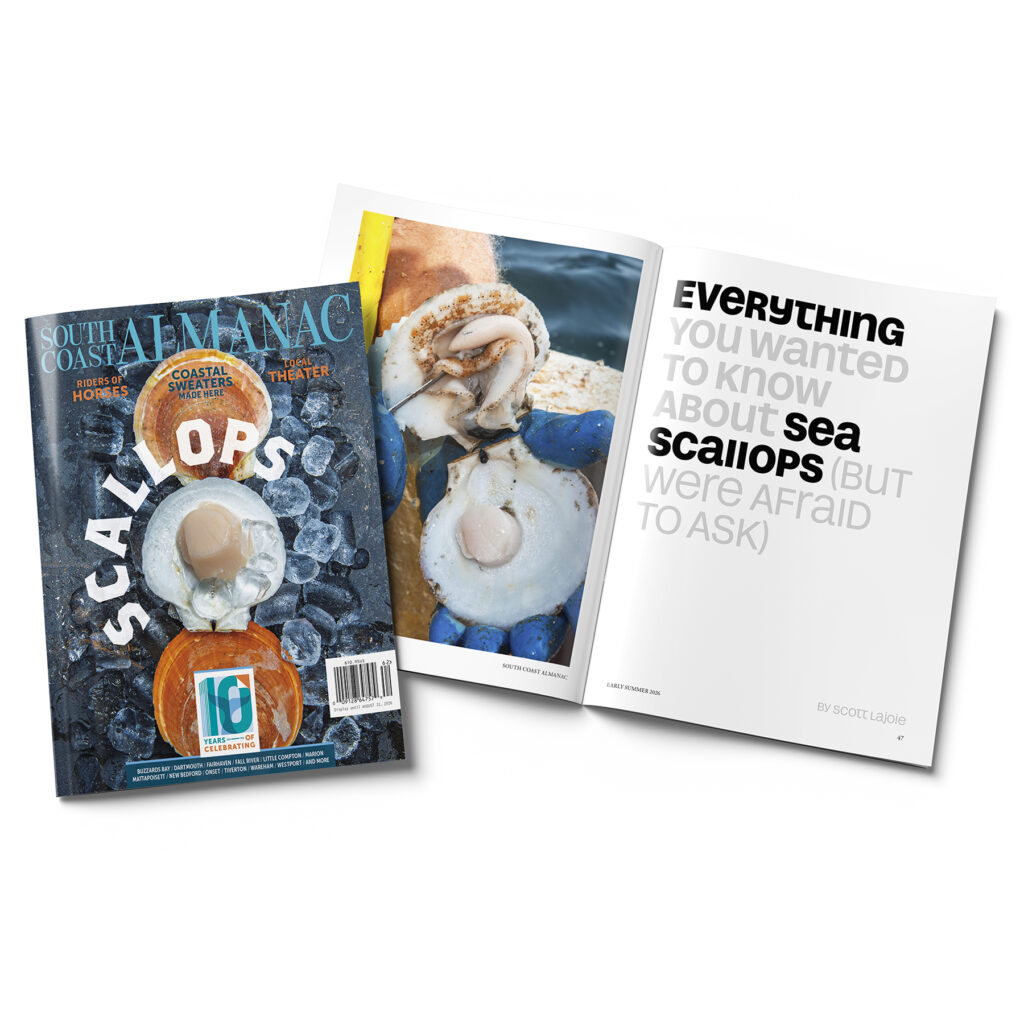
The Atlantic sea scallop industry is the largest wild scallop fishery in the world, with annual commercial landings in the US recently totaling nearly $500 million a year, according to the National Oceanic and Atmospheric Administration’s commercial fishing landings database. New Bedford, the most valuable fishing port in the nation since 2001, alone lands anywhere from 20 to 50 million pounds of the total each year. Scallop population dynamics, fishing catch limits, and other challenges to the industry can be very complex. We do our best to break it down here.
Photography by Phil Mello
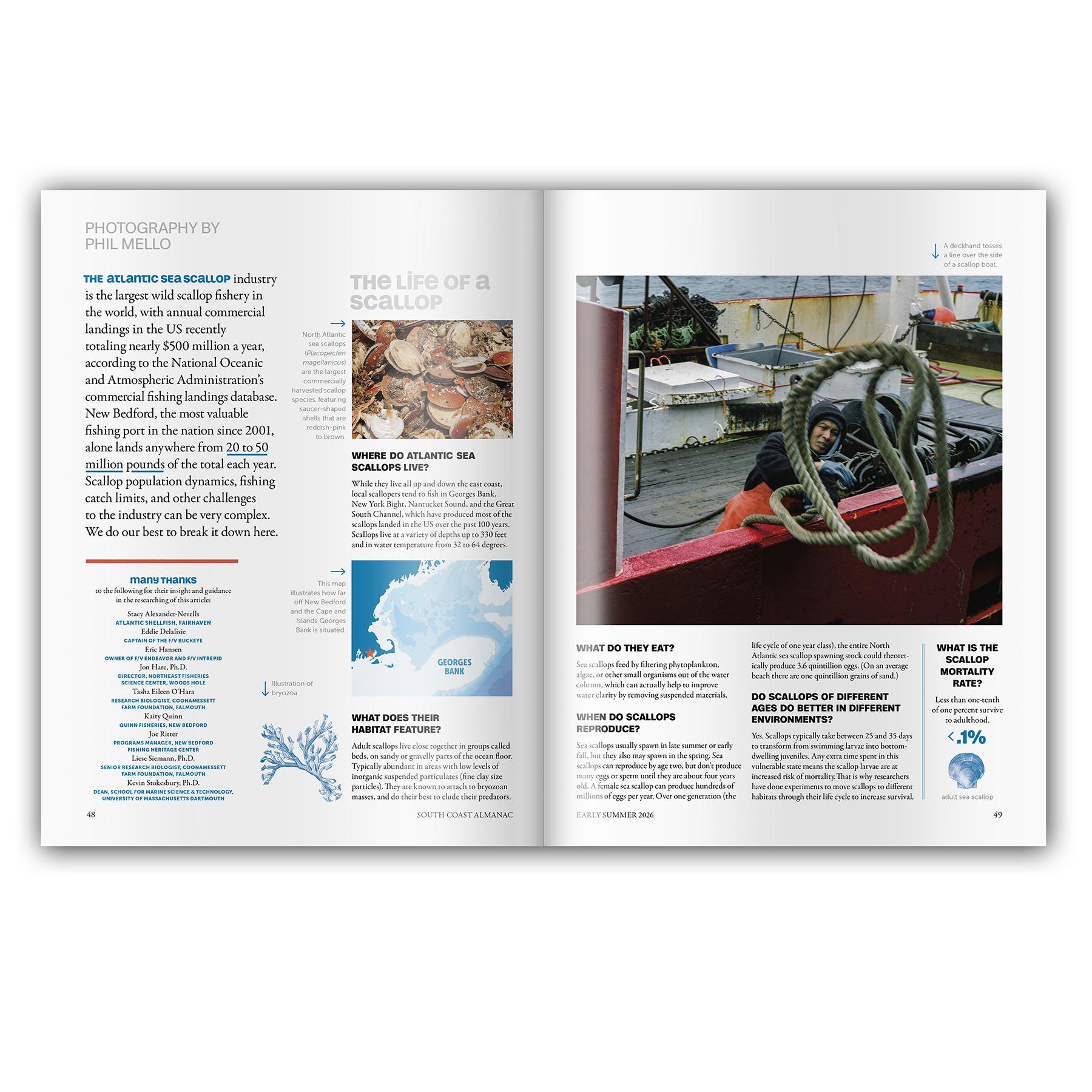
The Life of a Scallop
Where do Atlantic Sea Scallops Live?
While they live all up and down the east coast, local scallopers tend to fish in Georges Bank, New York Bight, Nantucket Sound, and the Great South Channel, which have produced most of the scallops landed in the US over the past 100 years. Scallops live at a variety of depths up to 330 feet and in water temperature from 32 to 64 degrees.
What does their habitat feature?
Adult scallops live close together in groups called beds, on sandy or gravelly parts of the ocean floor. Typically abundant in areas with low levels of inorganic suspended particulates (fine clay size particles). They are known to attach to bryozoan masses, and do their best to elude their predators.
What do they eat?
Sea scallops feed by filtering phytoplankton, algae, or other small organisms out of the water column, which can actually help to improve water clarity by removing suspended materials.
When do scallops reproduce?
Sea scallops usually spawn in late summer or early fall, but they also may spawn in the spring. Sea scallops can reproduce by age two, but don’t produce many eggs or sperm until they are about four years old. A female sea scallop can produce hundreds of millions of eggs per year. Over one generation (the life cycle of one year class), the entire North Atlantic sea scallop spawning stock could theoretically produce 3.6 quintillion eggs. (On an average beach there are one quintillion grains of sand.)
Do scallops of different ages do better in different environments?
Yes. Scallops typically take between 25 and 35 days to transform from swimming larvae into bottom-dwelling juveniles. Any extra time spent in this vulnerable state means the scallop larvae are at increased risk of mortality. That is why researchers have done experiments to move scallops to different habitats through their life cycle to increase survival.
What is the scallop mortality rate?
Less than one-tenth of one percent survive to adulthood.
How much do they travel?
When they spawn, they can travel tens or even hundreds of kilometers in currents. When juveniles, they will travel anywhere from 1 km up to 3 km by clapping their developing shell together in the water column. It is thought that the sea scallop’s smooth shell is an adaptation to allow it to propel itself faster and farther. Once an adult, they become relatively sedentary.
Can scallops see?
Sea scallops have up to 200 tiny, bright blue eyes that function like reflecting telescopes to detect movement and shadows. While not capable of seeing sharp images, these eyes can perceive nearby threats, such as predators, and changes in light within their immediate vicinity.
What are the sea scallops’ predators?
Sea stars, crabs, moon snails, and whelks. It is believed that a single large sea star can eat two scallops a day.
What is being done to protect scallops from sea stars?
Because large-scale population outbreaks of sea stars have had a devastating effect on Pacific Ocean coral reefs, researchers from other countries have tried luring them together in large numbers by releasing synthetic pheromones into the water and culling them. Researchers have been testing vinegar injections, which will not harm other animals in the process, but it is very labor-intensive and/or expensive. The Coonamessett Farm Foundation has trialed a “mop” that attracts sea stars so they can be pulled up out of scallop beds and culled on ship decks.
The Scallop Industry
What do boats use to catch scallops?
Scallopers use a dredge with an opening that is approximately 16 to 18 inches high that includes a steel-ring bag 10 to 15 feet long. They lower it and drag it along the sea floor before raising it up when it is full. Ring size is an important factor that dictates the size of scallops retained in a dredge, with smaller rings retaining smaller scallops. Field trials led to a gradual increase in the ring size of commercial scallop dredges over 10 years. The current regulated ring size is 4 inches.
What finfish bycatch do scallopers encounter?
Led by researchers at the Coonamessett Farm Foundation, the Virginia Institute of Marine Science’s Sea Scallop Research Program helped assess dredge modifications to reduce the catch of several finfish species routinely caught in sea scallop dredges, including various species of flatfish. So-called twine tops, large mesh panels, allow fish to escape out the top of the bag.
How has the fishery made modifications to gear to reduce turtle bycatch?
Turtle deflector dredges feature a front end at an angle and have eliminated gaps in the frame where turtles could get lodged, creating something like the cow catcher on an Old West steam locomotive. James Gutowski of the Viking Village scallop boat fleet and Ron Smolowitz, founder of the Coonamessett Farm Foundation, studied turtles to inform the design of this innovative dredge. Also, an app to track sea turtles, that was used on the West Coast, is being piloted in the Atlantic.
How are scallop catches processed on the boats?
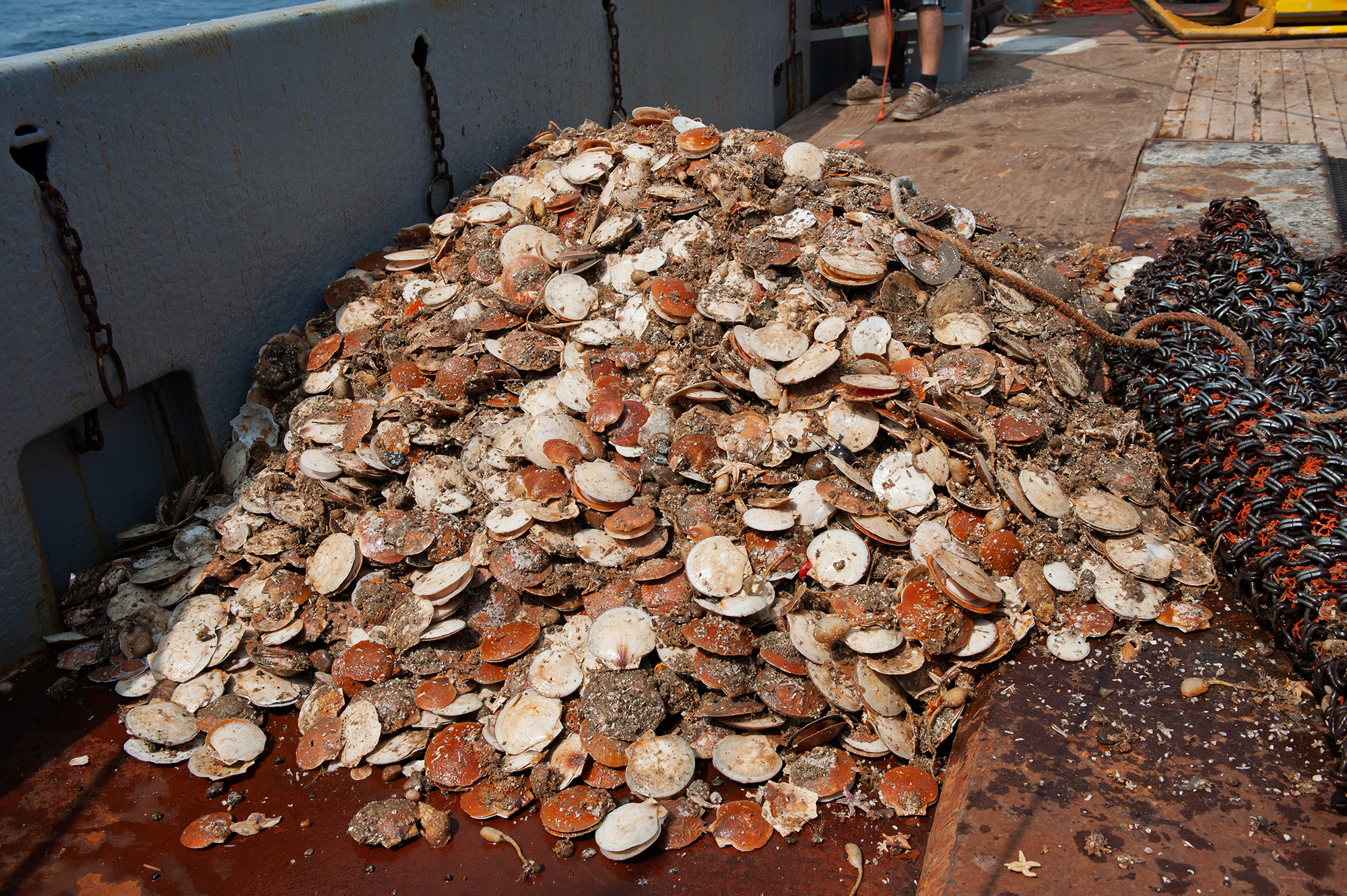
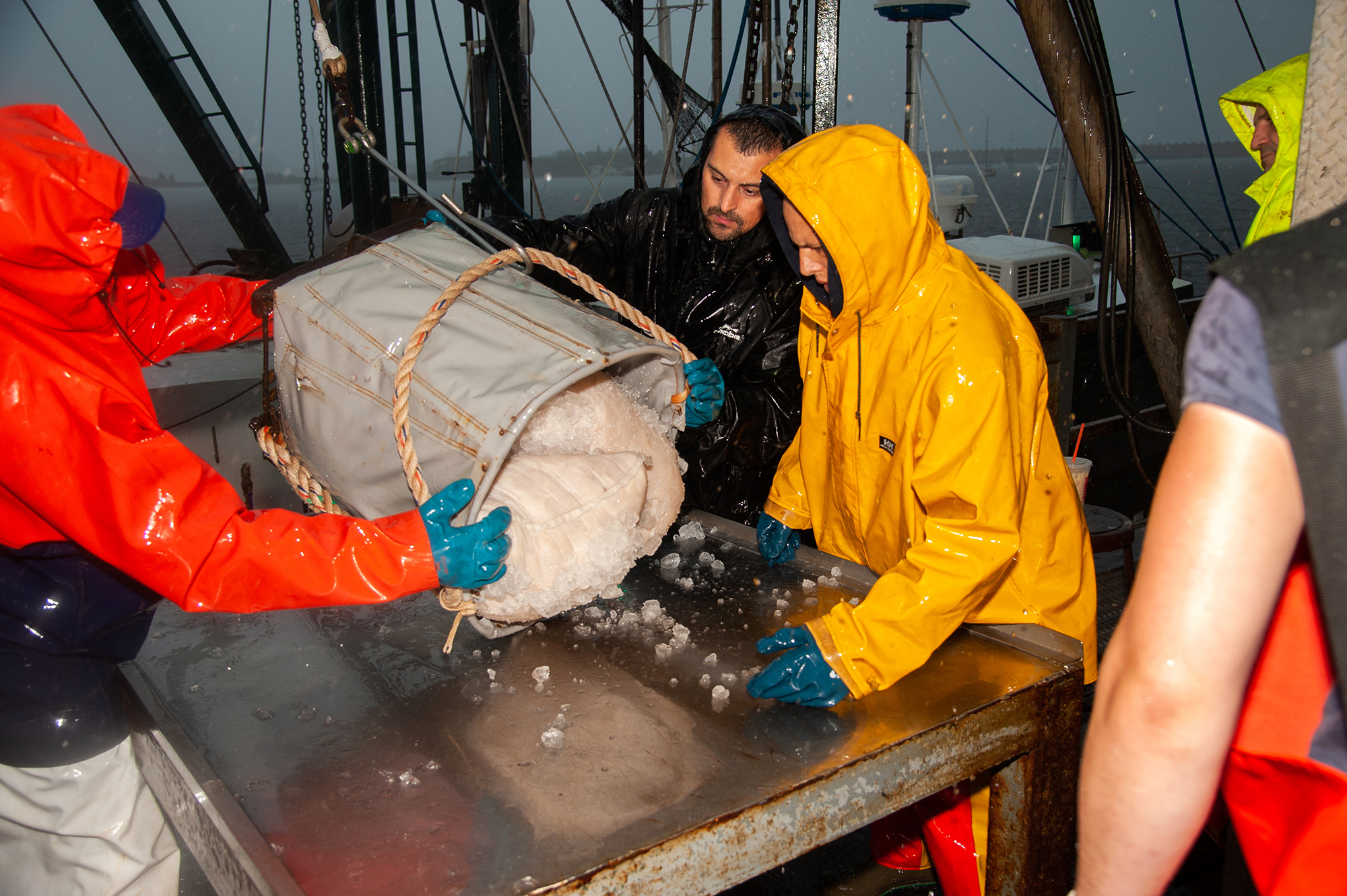
When the gear is hauled back, the scallops are dumped on the deck. The crew “picks the pile,” tossing scallops into bushel baskets and rocks and incidental catch overboard. Scallops are hand-shucked into buckets, rinsed, and placed in special muslin bags, tied off with wire. The 50-lb. bags are stored on ice in the fish hold. On a 10-day trip, a single fisherman will shuck some 50,000 scallops.
What causes people to get into scalloping?
Many scallopers have family that have done it before them. For others who have not, they realize it is a job that often offers great reward for hard, exhausting work. They like it, and
they are hands-on learners.
What causes attrition in scalloping?
A life at sea for long periods of time and being away from family can force someone to miss many memorable or milestone events.
How many boats does an outfit own?
It varies widely. Some outfits own a single boat. Atlantic Shellfish owns 18 scallop boats. Nordic Fisheries and O’Hara Corporation operate the largest fleet in the scallop industry.
 What is considered a record haul of scallops?
Last year, between 2.4 and 5 million pounds of scallops were harvested by the fleet from the Nantucket Lightship West (Closed Area) in only 24 days. At one point that June, there were 85 boats fishing in that finite location. A single vessel has been known to land more than 50,000 lbs. in a two-week period.
What shoreside operations do fishing companies own?
Eastern Fisheries owns New Bedford Cold Storage, cold storage with a 2,000-pallet capacity and New Bedford Ice, which produces more than 200 tons of ice daily for fishing vessels and seafood processing plants throughout New England.
Who did Carlos “The Codfather” Rafael sell his six scallop vessels to?
Quinn Fisheries bought them for $40 million.
How many people are considered part of the scallop industry in New Bedford?
Among New Bedford’s port working waterfront of nearly 7,000 people, about 10 percent work in scalloping.
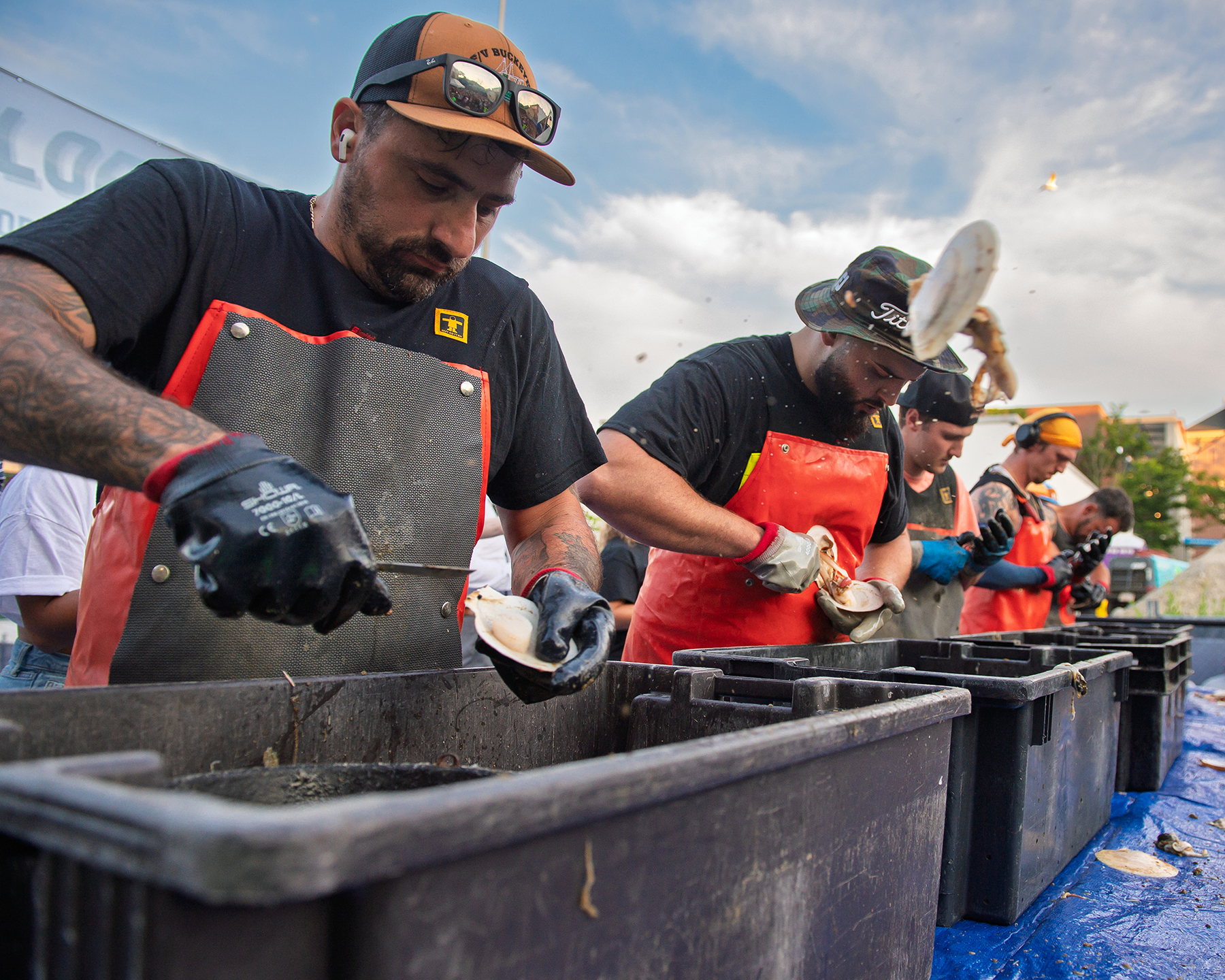 How do you shuck a scallop?
Hold it with the flat shell facing up, insert a shucking knife into the hinge gap, and twist to open. Remove the dark visceral guts and slice the adductor muscle away from the top shell. The cleaner one can do it in smooth but quick motions, the better.
Research and Regulation
What governs the fisheries industry?
The Magnuson-Stevens Fishery Conservation and Management Act is the primary law governing marine fisheries in US federal waters. Originally passed in 1976, it aims to prevent overfishing, rebuild overfished stocks, manage bycatch, and protect marine habitats.
What are the days at sea restrictions and what areas are open and closed for 2026–2027?
36 days total of fishing per permit, as opposed to 24 the previous year. The Area II and Nantucket Lightship North and South Scallop Rotational Areas are closed for fishing this year. Elephant Trunk was available to fish starting on April 1 and Area I will be converted to open bottom on May 31, after the carryover period.
Will the Council vote any emergency closures?
There have been proposals to shut down an area if it is being overfished, but they have not come to fruition. Currently, there is no tool in Magnuson for quick action: an Emergency Action still takes a vote and that could take too long to address an issue.
Who advises the Fisheries Council on scallop fisheries?
The Scallop Plan Development Team (PDT) and Advisory Panel (AP) discuss survey data treatment decisions and process improvements as well as Council work priorities, including Northern Gulf of Maine sub-areas and regional days-at-sea allocations. The PDT is comprised of scientific researchers and policy makers; the AP, scallop industry fishermen and stakeholders.
How many fishermen are on the scallop committee?
Currently, local fisherman Eric Hansen is the sole New England representative from the industry and is one of the chairs. There are other fishermen on the Committee, but from the mid-Atlantic region.
How do we survey them?
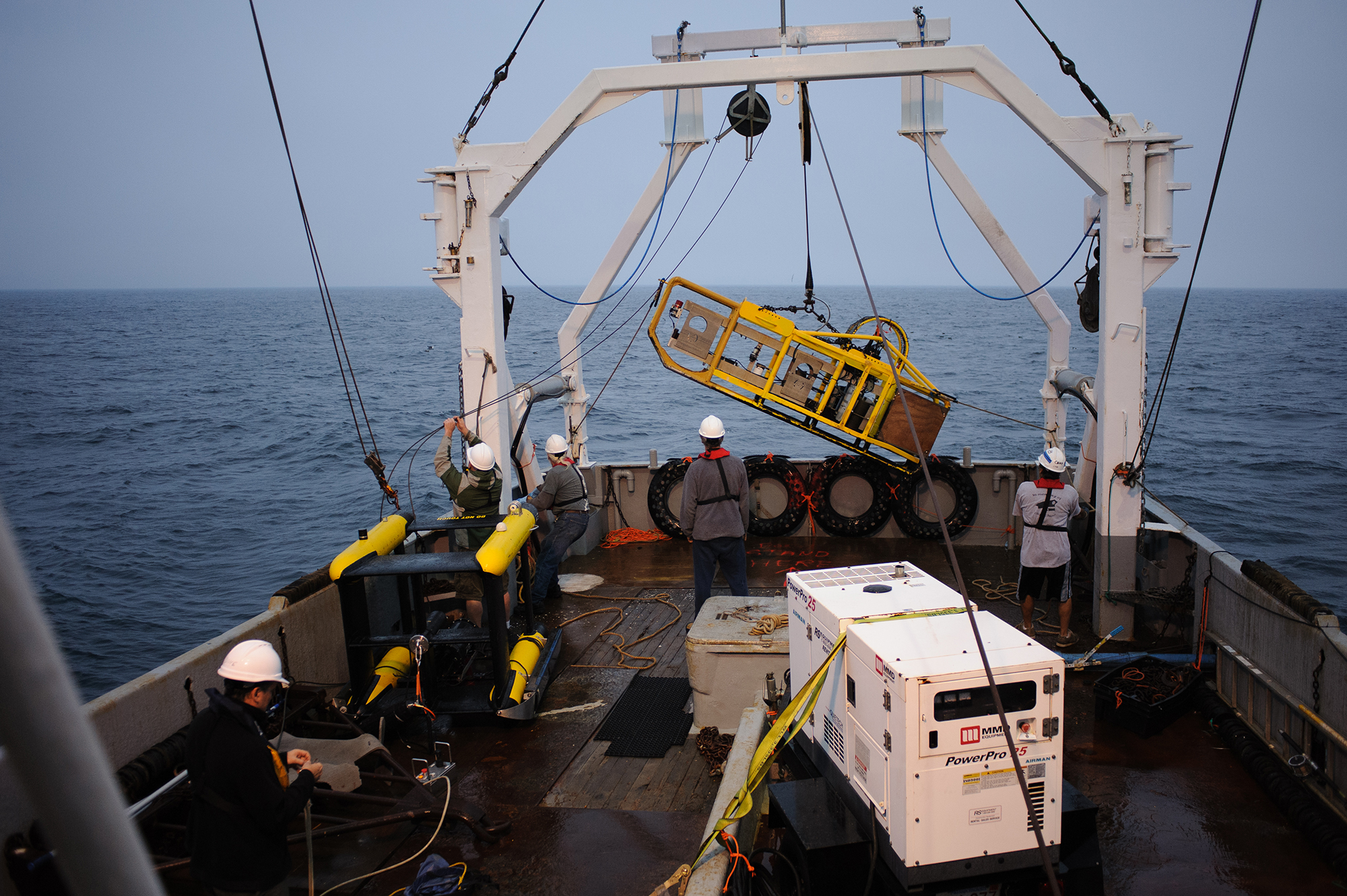
A drop camera is a stationary, vertical system lowered from a stopped vessel, which moves 50 to 60 meters, stops, then drops again. Extensive surveys with this approach were developed and conducted by SMAST’s Kevin Stokesbury. The HabCam survey uses a non-invasive system with dual cameras and oceanographic sensors. It is towed 24 hours per day by a commercial scallop fishing vessel outfitted with a steel A-frame, continuously surveying large areas while the boat is in motion. It collects more than a half million images each full day. Most HabCam trips are 10 days long. There are dedicated dredge surveys that are conducted each year by VIMS and the NEFSC in Georges Bank and the Mid-Atlantic, and by the State of Maine in the Gulf of Maine.
How can you identify sea scallops?
Sea scallops have a saucer-shaped shell with a prominent hinge. Sea scallop shells are smooth and lack the prominent ribbing that is characteristic of most other scallop shells. The upper shell is usually reddish-pink or brown in color. The lower shell is white or cream. A small percentage (5–10 percent) of sea scallops are albinos, with white upper and lower shells.
What is the schedule for population study and setting catch limits?
Most of the survey work is done April through July. Numbers are collected and put into reports that go to the PDT. They provide analyses and recommendations to the Council, which set catch limits in the late fall for the following season of April 1 to March 31.
Are they brought on board to be studied?
Previously, dredged samples were collected, brought up on the research vessel or fishing boat, and measured by hand to be counted. Now, only some dredged samples are collected in such a way for biological study and measured to determine the health of individuals.
How is the data reviewed and used?
Highly trained annotators review a subsample of underwater imagery collected, before quality assurance review from a project manager. It is then shared with the councils and used in assessments. All groups produce deliverables such as maps of biomass, and density and distribution of scallops at different sizes, and length frequencies or growth. All compiled reports are made publicly available.
Are there disadvantages to a towed camera?
Researchers on a NOAA-chartered vessel lost a $450,000 camera that was being towed underwater when a cable apparently snagged on a sunken ship near Delaware Bay, delaying scallop surveys. But such accidents are rare.
Has AI been employed to do this monitoring?
Yes, but the technology is thought to be only about 70 percent accurate. Humans are much better at picking up movement and can better differentiate between a scallop and a sand dollar, when both are partially buried in sand. CFF disputes this, saying its detectors are higher than 70 percent accurate.
What other technology is being used to benefit research?
A long-range autonomous underwater vehicle called Stella is currently being tested to visually record scallop populations without any human supervision. It carries the same imaging package as the HabCam but can be programmed to cover areas on its own, instead of being towed by a boat. Stella was developed for surveying inside the new wind energy development areas, as large vessels will likely not operate among the multiple turbines planned within wind energy areas. Eventually researchers will be able to release Stella from shore for a round trip to a survey area.
How can scallopers share information with their fellow scallopers?
ScallApp is a custom mobile application developed by the Commercial Fisheries Research Foundation (CFRF). It was designed for fishermen to record and submit real-time, geotagged biological data on sea scallops, including life stage progression and health, directly from the field.
What financially supports research?
Research Set-Aside (RSA) Programs are unique to federal fisheries in the Greater Atlantic Region. No Federal funds are provided to support the research. Instead, research funds are generated through the sale of set-aside allocations for quota managed or days-at-sea (DAS) managed fisheries. For the Scallop RSA, the Fisheries Council reserves 1.275 million pounds of scallops per year. This generates approximately $20 million, of which approximately $5 million supports research projects.
How may wind farms affect the scallop industry?
According to a study published last December by Rutgers University Haskin Shellfish Research Laboratory’s Sarah Borsetti, offshore wind may not change scallop fishing more than an estimated four percent increase in travel time to scallop sites to avoid turbines.
Eating Scallops
What part of the sea scallop do we eat?
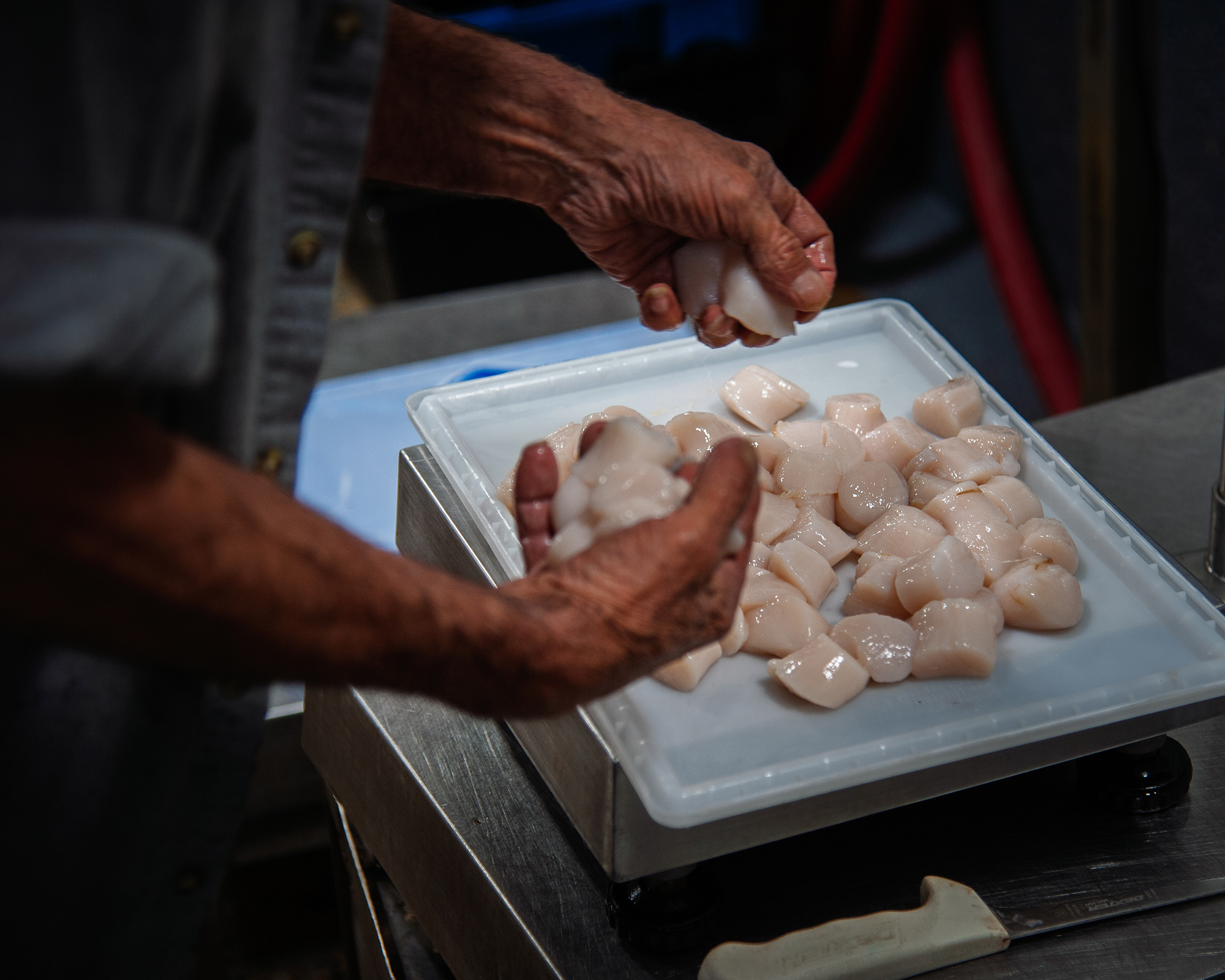
The shells are held together by the adductor muscle, the part of the scallop we typically eat, although many parts of the scallop are edible.
How are scallops sized?
Scallop sizes are measured by the number of shucked scallops per pound. You will typically see a range indicating the minimum and maximum count. For instance, “10-20” means there are between 10 and 20 scallops in a pound. The lower the number range, the larger the individual scallops. 40-50 size is considered too immature for harvesting.
How do sea scallops differ from bay scallops?
Bay scallops tend to weigh in at 60-120+ in a pound, boasting a slightly sweeter taste with tender meat about ½ to 1 inch in diameter. Sea scallops have a pleasantly briny yet sweet and chewier texture at 1 to 2¾ inches across. Bay scallops were once to Buzzards Bay what oysters were to the embayments of Cape Cod Bay, Chesapeake Bay, and Long Island Sound: highly valuable and deeply connected to our culture. But today, our once-abundant bay scallops have all but disappeared due to water quality declines. This issue was highlighted in John Stanton’s 2016 documentary The Last Bay Scallop?, which examines the last commercially viable bay scallop fishery on the East Coast.
What were the problems marketing sea scallops?
Consumers unfamiliar with scallops had to be convinced they weren’t some imitation or manufactured by-product from skate wings or some other low-cost species. A 1939 article in a New York newspaper noted “Even those who have eaten scallop with a smacking realization of their goodness have harbored a vague belief that the small, soft round scallop, which bears no outward likeness to crab or oyster, fish, lobster, shrimp or clam, was punched… out of some fish… with a circular metal device.”
How are they sold at market?
BASE Seafood Auction begins at 9 am, Monday through Friday. Scallop vessels unload daily from 11 am the day before to 6 am the day of, with product prepared promptly for the morning sale. Before any bids are placed, product is offloaded, culled by count, weighed, iced, and placed in the cooler. Lots are grouped by harvest area and size, ranging from 100 to 1,500 pounds. The winning buyer has a few seconds to claim a quantity—up to 20,000 pounds of the same size and area. The seller then has time to either accept or scratch the bid. Scratched lots move into a second auction round, with a third round available if needed.
How do you sear scallops?
Use a hot, heavy-bottomed skillet (like stainless steel or cast iron) over medium-high heat with a high-smoke-point oil (e.g., grapeseed). Sear undisturbed for only 2-3 minutes, flip once, and sear another couple of minutes. Avoid overcooking to keep them tender.
What flavors can one add?
From New Bedford’s own Azorean Green Bean chef Maria Lawton (azoreangreenbean.com/pan-seared-scallops): For one pound of scallops, melt a cup of butter and your drop in 3-4 cloves of chopped garlic and 2-4 sprigs of rosemary. Once the butter, garlic, and rosemary have blended, remove your rosemary and add in your scallops. Garnish with fresh lemon juice.
Many thanks to the following for their insight and guidance in the researching of this article:
Stacy Alexander-Nevells, Atlantic Shellfish, Fairhaven
Eddie Delalisie, Captain of the F/V Buckeye
Eric Hansen, Owner of F/V Endeavor and F/V Intrepid
Jon Hare, Ph.D., Director, Northeast Fisheries Science Center, Woods Hole
Tasha Eileen O’Hara, Research Biologist, Coonamessett Farm Foundation, Falmouth
Kaity Quinn, Quinn Fisheries, New Bedford
Joe Ritter, Programs Manager, New Bedford Fishing Heritage Center
Liese Siemann, Ph.D., Senior Research Biologist, Coonamessett Farm Foundation, Falmouth
Kevin Stokesbury, Ph.D., Dean, School for Marine Science & Technology, University of Massachusetts Dartmouth
The Birth and Development of the American Sea Scallop Industry
By Daniel Georgianna
Excerpted from The Secret Life of Scallops: High Stakes on the High Seas, to be published by Spinner Publications, Inc.
In the early 1800s, sea scallops that were harvested near shore in the deeper waters of northeastern Maine and the Bay of Fundy were highly prized by the small local market. But the cost to ship them the major seafood markets far from Downeast Maine caused them to fall out of favor to Maine fishermen. They became more of a curiosity than a profitable catch.
Larger beds of sea scallops were discovered later that century in the shallower waters around Mount Desert Island and in the coastal towns southwest of the Island by fishermen who used modified oyster dredges drawn by sail to harvest them. As many as 20 fishermen from Mount Desert, Pretty Marsh, and Bartlett’s Islands dredged the local waters and delivered sea scallops to Boston. In the winter of 1886-87, fishermen at Little Deer Isle joined the harvest and scallopers harvested 5,000 bushels.
By 1889, the market for the sea scallops of Maine had blossomed. By year’s end, the industry recorded that nearly 300,000 lbs. of meat had been landed in Maine. Vessels from Boston and Gloucester joined in, landing an additional 28,500 lbs. The sea scallop was on its way.
During the early years of the 20th century, sea scallopers of Maine took advantage of newer technology of larger vessels with higher horsepower engines that allowed them to dredge the deeper, rockier bottoms in the Gulf of Maine for sea scallops and deliver their catch to Boston.
Sea scallops and bay scallops sold side by side at the Fish Pier, with bay scallops being considered a “sweeter” product. Although the Maine deep sea scallops were twice the size of the bay scallops, bay scallops brought about double the price of sea scallops per pound.
But bay scallops were only available in the r-months of the year, and were often not available during bad weather in those wintery months. Sea scallops, though not as popular, did not have strict seasonal restrictions and were available from larger, sea-worthy vessels when bay scallops were not.
The New Bedford sea scallop sales and marketing started during the early 20th century and grew in fits and starts until the 1920s when Maine and Newfoundlanders scallopers moved south and New York scallopers, mostly Norwegians, moved north to New Bedford. They found a city down on its luck next to one of the world’s richest fishing grounds: large sea scallop beds not far from New Bedford harbor.
The modest success of the sea scallop fishery in downeast Maine and the discoveries of vast scallop beds off Long Island and New Jersey put sea scallops on the menu in New York City and other large East Coast city markets. A few Maine scallopers decided to try the scallop grounds off Provincetown, and Nantucket Sound near New Bedford harbor.
New Bedford-based fishermen from Newfoundland and Norway were used to fishing offshore and were attracted to the deeper waters of Georges Bank.
From a small start of a few thousand pounds per year, New Bedford became the world’s leading sea scallop port in the late 1930s.
A Timeline of Scalloping in New Bedford
Timeline adapted from the New Bedford Fishing Heritage Center’s “A Century of Progress and Innovation: The New Bedford Fishing Fleet.” For this timeline in its totality, go to fishingheritagecenter.org/exhibits/industry-timeline.
1930s At the start of the 1930s, New Bedford’s fleet and its landings are growing fast. Besides the usual landings of flounder and groundfish, sea scallops are now being harvested. This is a fairly new fishery and New Bedford’s fleet, located relatively close to the rich George’s Bank scallop beds, is poised to corner the market early on.
1931 Department of Commerce completes a thorough survey of Georges Bank, producing a new edition of its nautical chart, an invaluable resource for the fleet.
1934 Out of the ten big scallop draggers fishing on George’s Bank, seven are from New Bedford.
Late-1930s New Bedford is the center of the growing sea scallop fishery. 95% of the scalloping fleet lands their catch in New Bedford. New Bedford vessels are now landing most of their catch at home instead of other ports.
1950s The 1950s see the arrival of new technologies for gear, navigation and the vessels themselves. However even with the introduction of steel construction, much of the fleet is still comprised of wooden Eastern-rig draggers and scallopers.
Mid-1950s New Bedford fisherman Andrew Olden receives a patent for an improved scallop dredge.
Late 1950s The nation’s leading scallop port begins celebrating its success with the New Bedford Scallop Festival.
1960s By the mid-1960’s, 95% of all scallops landed come into New Bedford. Total landings for the port in 1965 top 135 million pounds and are valued at over $18 million. Scallop landings are over 10 million pounds, bringing in over $7 million. Yellowtail flounder amounts to over 59 million pounds, worth nearly $6 million.
1966 Completion of the hurricane barrier in New Bedford harbor. The barrier ensures that the New Bedford waterfront and fleet will not have to repeat the level of destruction wrought by the hurricanes of 1938 and 1954. The New Bedford scallop fleet has about 60 vessels at this time. However, the George’s Bank scallop beds are showing signs of depletion.
1968 Scallop landings and prices are on the decline. Four large New Bedford scallopers leave for Alaska. The New Bedford Scallop Festival is re-named the New Bedford Seafood Festival as scallops decline and yellowtail flounder landings increase. Roy Enoksen establishes Nordic Fisheries with the purchase of his first scalloper, F/V Sea Trek.
1980s In the early 1980s George’s Bank scallop beds begin to rebound.
1980 Bendiksen Fisheries launches the 98' Viking, a combination scalloper-dragger and the first of its type.
1982 Implementation of the Atlantic Sea Scallop Fishery Management Plan. Walter and Wayne Bruce develop and patent anti-chafing gear known as “cookies” for scallop dredges (US patent #434972, 9/21/1982). They are usually made from old vehicle tires and prevent damage to the chain bag as it scours the bottom.
1990s In the early 1990’s, thanks to its scallop fleet, New Bedford is the leading fishing port in the nation in total dollar value. The fleet numbers over 300 vessels, mostly scallopers and draggers.
1994 Whaling City Seafood Display Auction is created by brothers Richard and Raymond Canastra. Unlike the original New Bedford Auction, this one is a European style display auction. The catch is unloaded, culled, and on display for prospective buyers. Amendment 4 to the Atlantic Sea Scallop Fishery Management Plan imposes major changes in scallop management, including days-at-sea (DAS) limits, new gear regulations to reduce by-catch, a vessel monitoring system and a change in how scallop permits are allocated.
Mid-1990s New Bedford’s fleet, like the rest of New England’s is burdened by Amendment 5 of the Northeast Multispecies Fishery Management Plan. Two large areas of Georges Bank and the Nantucket Lightship area are closed to both the groundfish and scallop fleet. New regulations enforce net mesh sizes, days-at-sea (DAS) and end the use of combination scallop-dragger vessels.
1996 The Sustainable Fisheries Act of 1996 makes major revisions to the original Magnuson Act. Now known as the Magnuson-Stevens Act, it enforces restrictions to prevent overfishing and to rebuild stocks. It adds and revises national standards on vessel safety, fishing communities, and incidental bycatch. It also imposes improved fishery monitoring, enhanced research and identification of essential fish habitat, and analysis of fishing capacity.
1998 Amendment 7 to the Scallop FMP changes the definition of overfishing, the days-at-sea (DAS) schedule and lowers scallop mortality targets. The Mid-Atlantic scallop beds of Hudson Canyon and the Virginia/North Carolina Areas are closed to scallopers. New Bedford’s lucrative scallop fishery hits a 25-year low, with annual landings valued at $30 million.
1999 Framework Adjustment 11 to the Scallop FMP allows a limited number of scallopers to dredge in the closed section of Georges Bank (Closed Area II). This successful experiment leads to a rotational system that closes areas and reopens them several years later to prevent overfishing and optimize yield.
2001 Sea Scallops are included in the Whaling City Seafood Display Auction.
2002 New Bedford’s offshore fleet numbers 108 scallopers and 96 draggers.
2006 As restrictions continue to hamper the groundfish fleet, New Bedford’s scallop landings are keeping the port on top. New Bedford’s total landings amount to 169.9 million pounds valued at $281.2 million.
2008 Amendment 11 to the Scallop FMP establishes a new management program for the general category scallop fishery. This includes a limited access program using IFQs for general category vessels and specific allocations for general category fisheries.
2011 New Bedford scallopers are allowed into Closed Areas I and II on Georges Bankwith allotments of 18,000 lbs. per vessel.
Ocean’s Fleet is formed from the merger of Fleet Fisheries and Oceans Alive Scallops, creating one of the largest producers of Atlantic sea scallops in the nation.
2017 The Working Waterfront Festival returns to Steamship Pier. Tropical Storm Jose forces the fleet to stay in the harbor thereby canceling the scallop shucking contest.
2019 F/V Leonardo, a 56-foot scalloper, capsizes in a storm off Martha’s Vineyard. The Coast Guard rescues one crew member; the other three fishermen on board are presumed lost at sea.
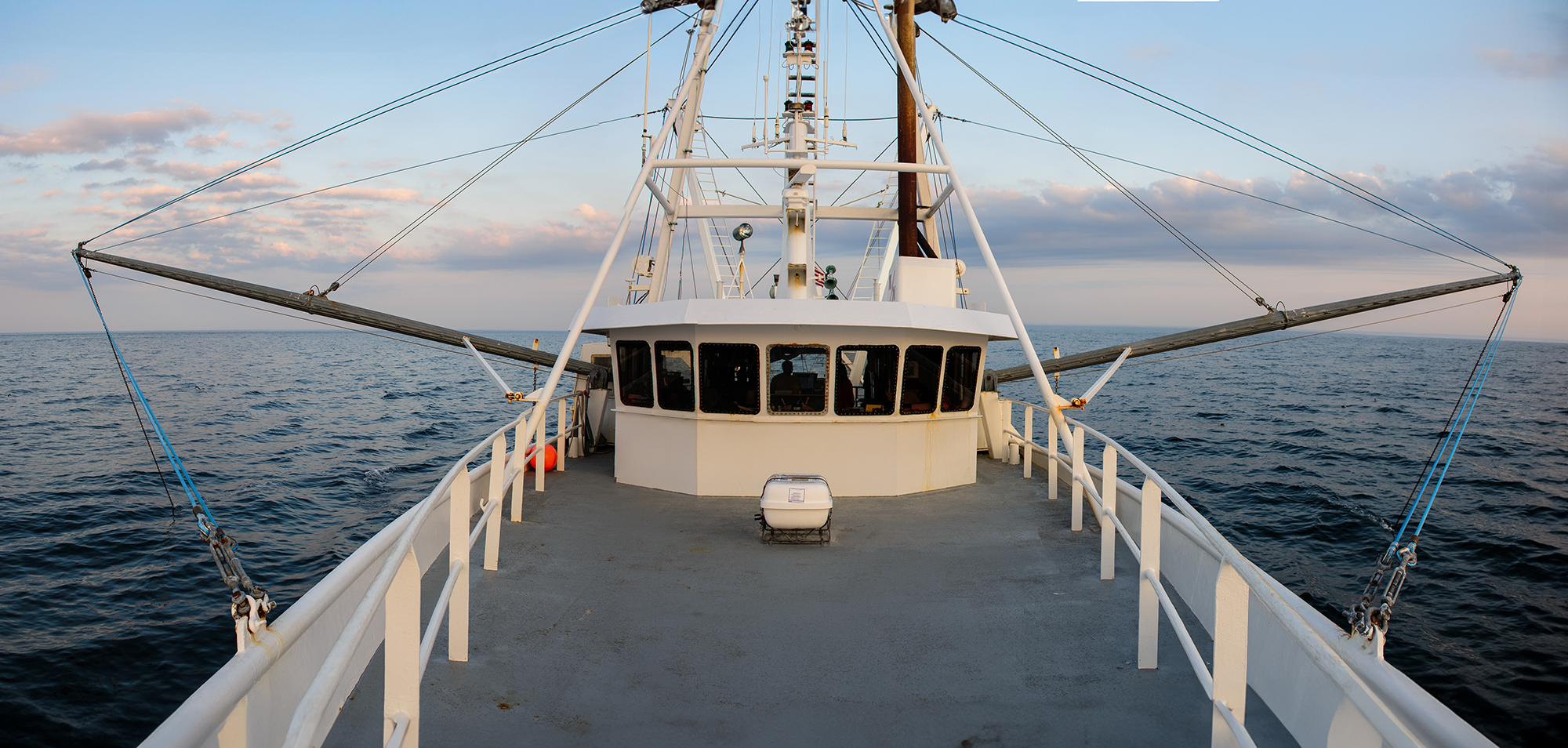
2020 F/V Viking Power, a brand-new state-of-the-art-scalloper joins the New Bedford fleet. With an innovative bow that slopes outward, the vessels is designed to be more fuel efficient and provide a better ride for the crew. In addition, the boat uses an A frame rig, instead of the more common gallows and booms.
2025 New Bedford Fishing Heritage Center produces the inaugural Scallopalooza, a scallop celebration and shucking contest.