
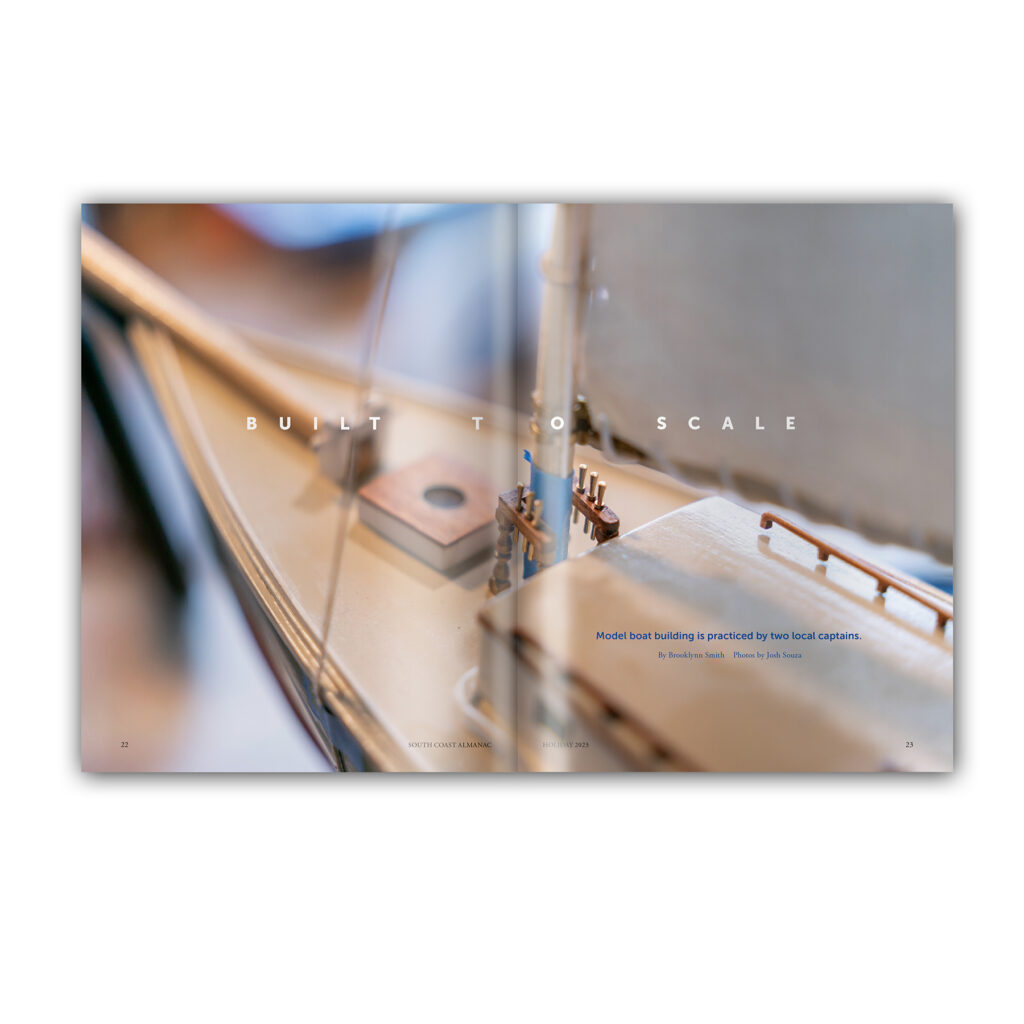
Model boat building is practiced by two local captains.
By Brooklynn Smith | Photos by Josh Souza
In the early hours of dawn, a golden sun sits above the horizon, creating soft shades of pink and lavender across the sky. Gentle waters lap up against the hulls of scallop boats in New Bedford Harbor, rocking them side to side. The salty sea smell layers thickly in the air, as seagulls cry and whirl in the sky.
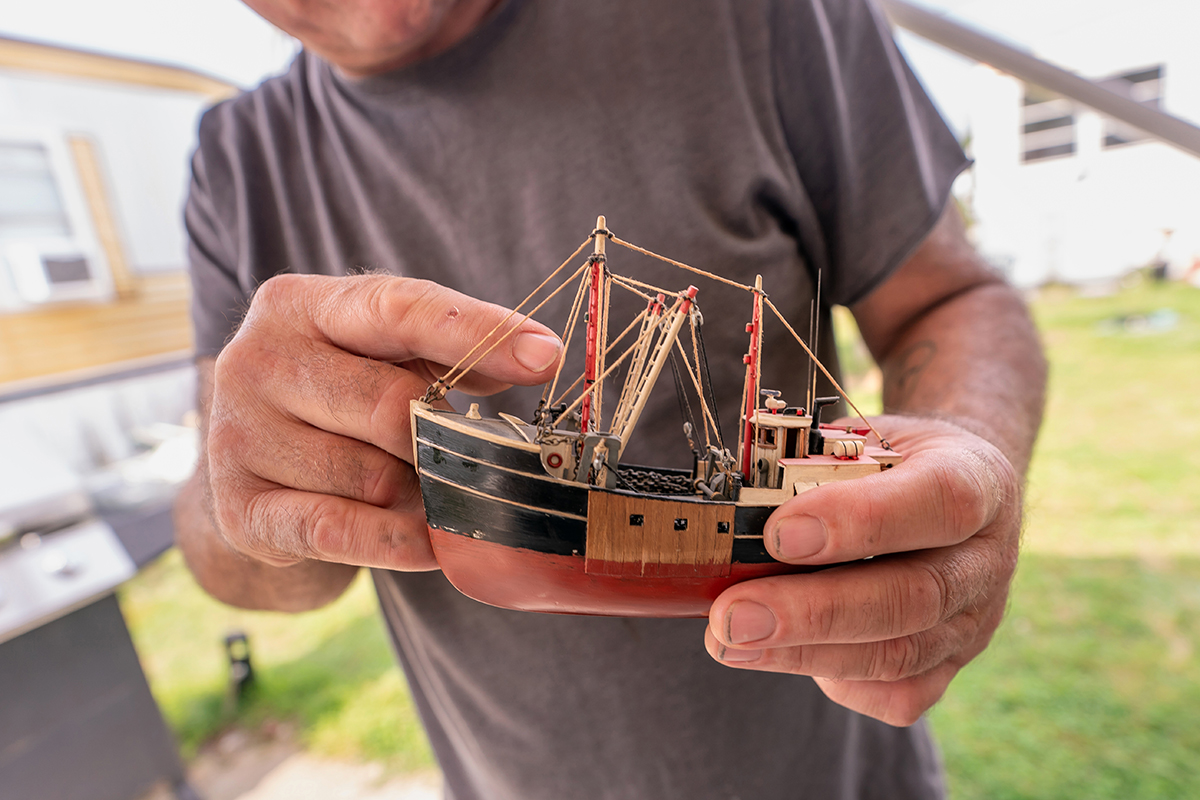
Sitting on top of a milkcrate on the deck of a boat he captains is Alan Curtis, a career scalloper hailing from this historic city. He carves a piece of basswood, carefully nicking away slivers to create the same shapes and curves of a boat in front of him. That piece of wood will eventually transform into a detailed version of a real boat, and be one of many models in his or a friend’s collection.
From a young age, Curtis was surrounded by the fishing lifestyle and was well acquainted with boats. His childhood memories are going down to the docks with his father, with coffee milk and an English muffin in hand, and seeing boats everywhere.
“It was my father who built model boats,” he explains. “He had first built plastic car models, then commercially manufactured plastic boats, then finally made wooden models from blueprints of scallopers. Ever since I was a kid, I was always infatuated with boats.”
At fourteen he was restless with his school studies, so Curtis’s father and school counselor planned for him a fishing trip one April vacation. When asked if that trip encouraged him to take his studies more seriously, Curtis happily admitted that it only reinforced his love for the sea and all that came with it.
It is very common for boat modelers to have begun their model building hobby by drawing first. Captain Curtis drew Eastern Rig boats as a kid for years until one day, he discovered that the drawings stopped looking right. He could draw the stern, bow and side perfectly. “But if I wanted to draw an angle on any of those pieces,” he says. “it just wasn’t going to happen.” The stifling of his creativity pushed him to explore new ventures in showing the boat’s beauty. He picked up a piece of wood, started carving it, and never looked back.
Following in the footsteps of his father and grandfather, Curtis is a third-generation scalloper. He proudly hoists tons of shellfish by day, and models old-styled Eastern Rig boats by night.
From the 17th through the 19th century, there was a strong wave in portraying majestic ships through paintings. These pieces of art showcased the raw strength of ships plowing through treacherous waters, such as George Philip Reinagle’s most famous painting, A First Rate Man-of-War Driven Onto Reef of Rocks, Floundering in a Gale. Or peaceful and tranquil, like Fitz Hugh Lane’s Becalmed off Halfway Rock.
Throughout those time periods, modeling boats was a practice primarily reserved for planning the construction of a full-sized boat. Shipwrights were tasked with building half-hull models of ships to aid in the ship’s ultimate design. As time progressed and other means of trade and travel advanced, modeling boats went from a shipwrights’ necessity for building to just pure pleasure for a hobbyist.
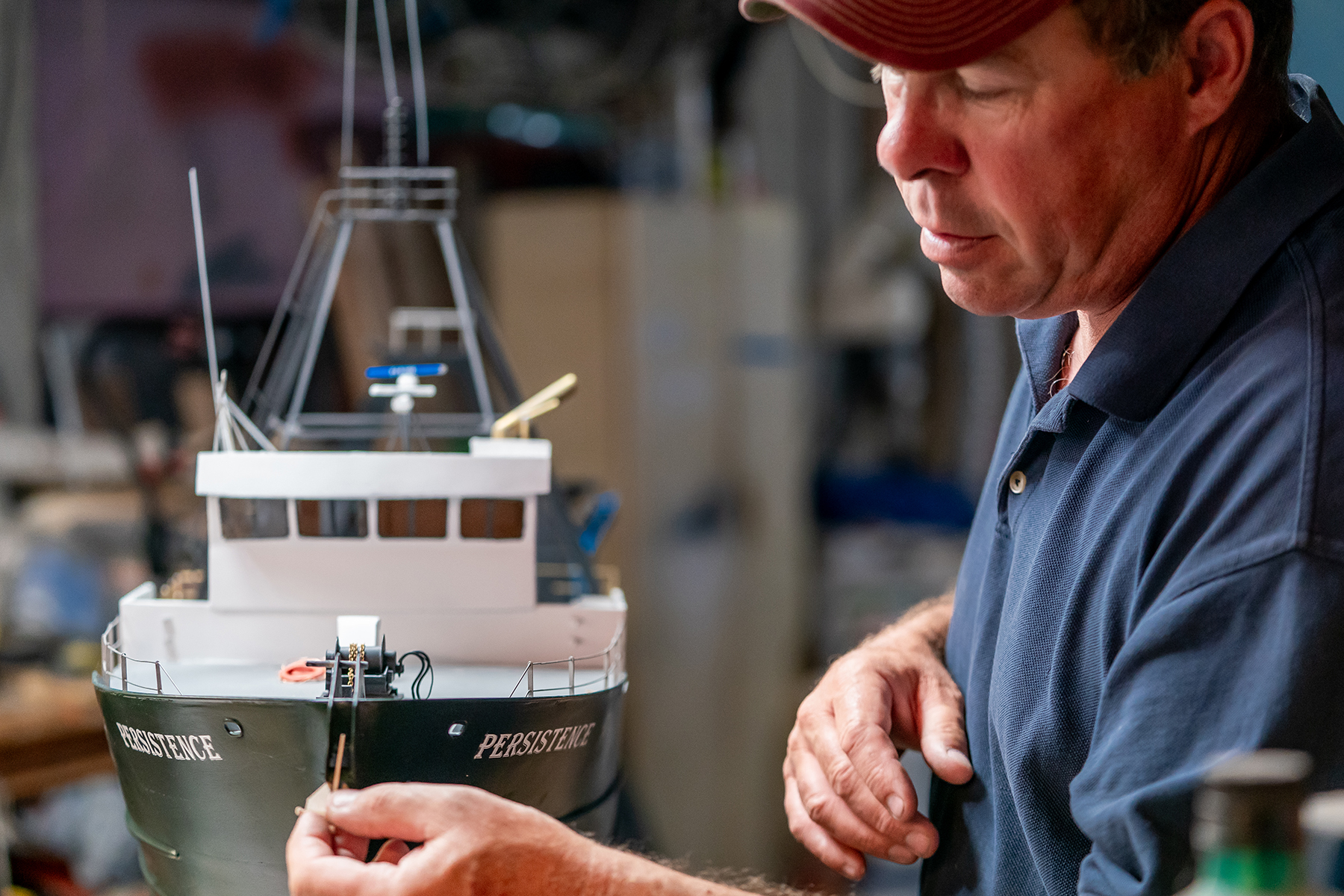
In today’s technologically advanced world we are comfortable with having products built at efficient speeds. We expect results almost immediately. But that is not how masterful art is created. When it comes to modeling boats from scratch it takes an exuberant amount of patience. “Anyone who wants to get into this hobby must learn to be patient,” warns Bruce Gifford, a lobsterman and tugboat captain.
Born and raised in Westport, Gifford was very familiar with the fishing boats in his community. As a boy, he would mimic the great boats he would see and make small models of them. These models were just made to float in pools. However, with his interest growing over time, he later would begin making models equipped with engines, then models powered by remote controls.
All of these milestones led him to his first commission in 1999. The wife of his employer at the time had asked him if he could build a model of their lobster boat, the Rebecca Ann Naomi, as a surprise. This request transformed his hobby from something personal to something that could bring meaning to others. “It’s a beautiful sight to see a captain’s eyes fill with tears as he holds a model of his boat that brought food to the table for his family,” Gifford says.
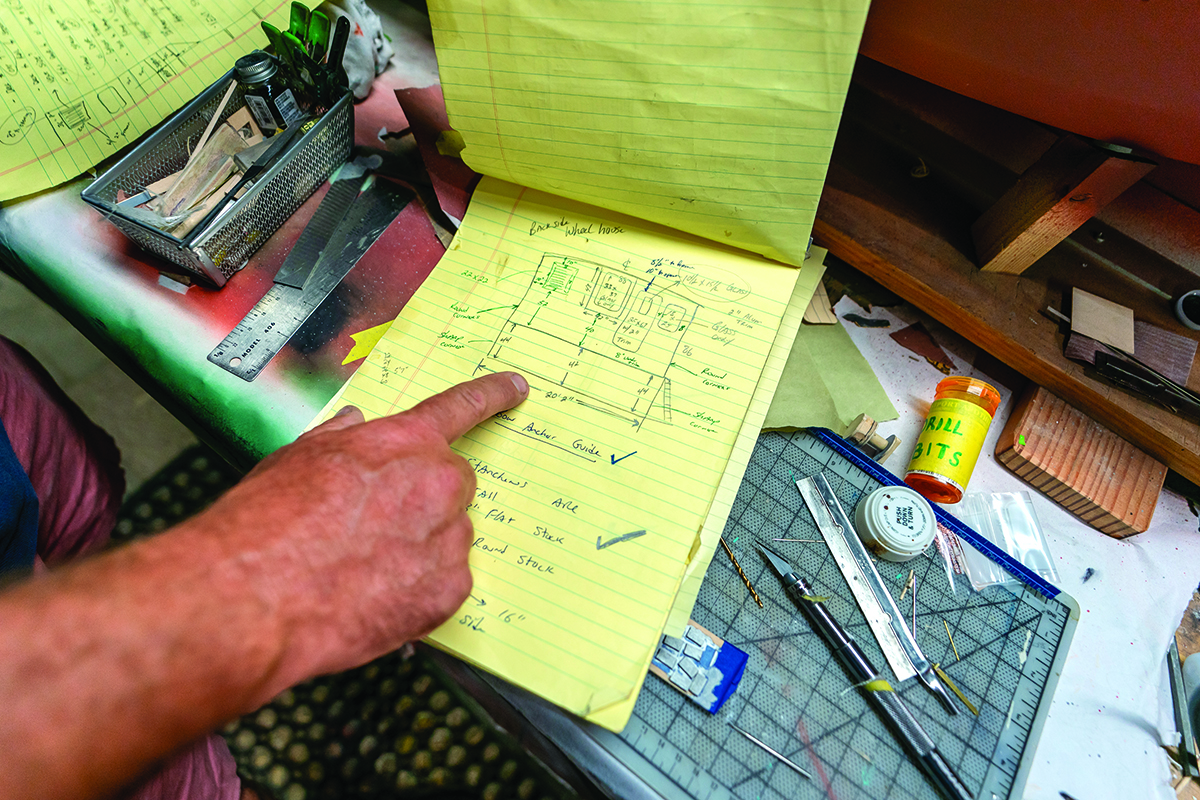
In the beginning stages of building, the modeler must get the dimensions and overall design of the boat. There are two ways to do this: by sketching or by obtaining the boat plans. If one chooses to draw sketches, they would have to see the life-sized boat. The sketches made are not ones you would probably see in a normal sketchbook. They’re usually interior parts of the boat drawn in vague, crude shapes. The modeler also measures certain areas and then sketches that in a scaled down version, usually three-eighths of an inch to a foot.
The second method is by using boat plans. There are three main views in the boat plan: keel view, profile view, and frame view. The Keel view is seen from the top of the bow up to the stern. In the Profile view, the boat is shown from the side. The Frame view shows the skeleton framework of the boat and displays where the frame patterns are on the keel.
Some modelers however choose to use none of these methods but to do something unconventional instead. Some prefer “to do everything by eye.” “I make everything fit to that size of the model without measuring. And so far it’s always worked out for me.” Having worked on many scallopers, Curtis developed a brilliant photographic memory of them. One boat that he takes great pride in making from just pictures and memory is the Eastern rig fishing vessel, the Patience.
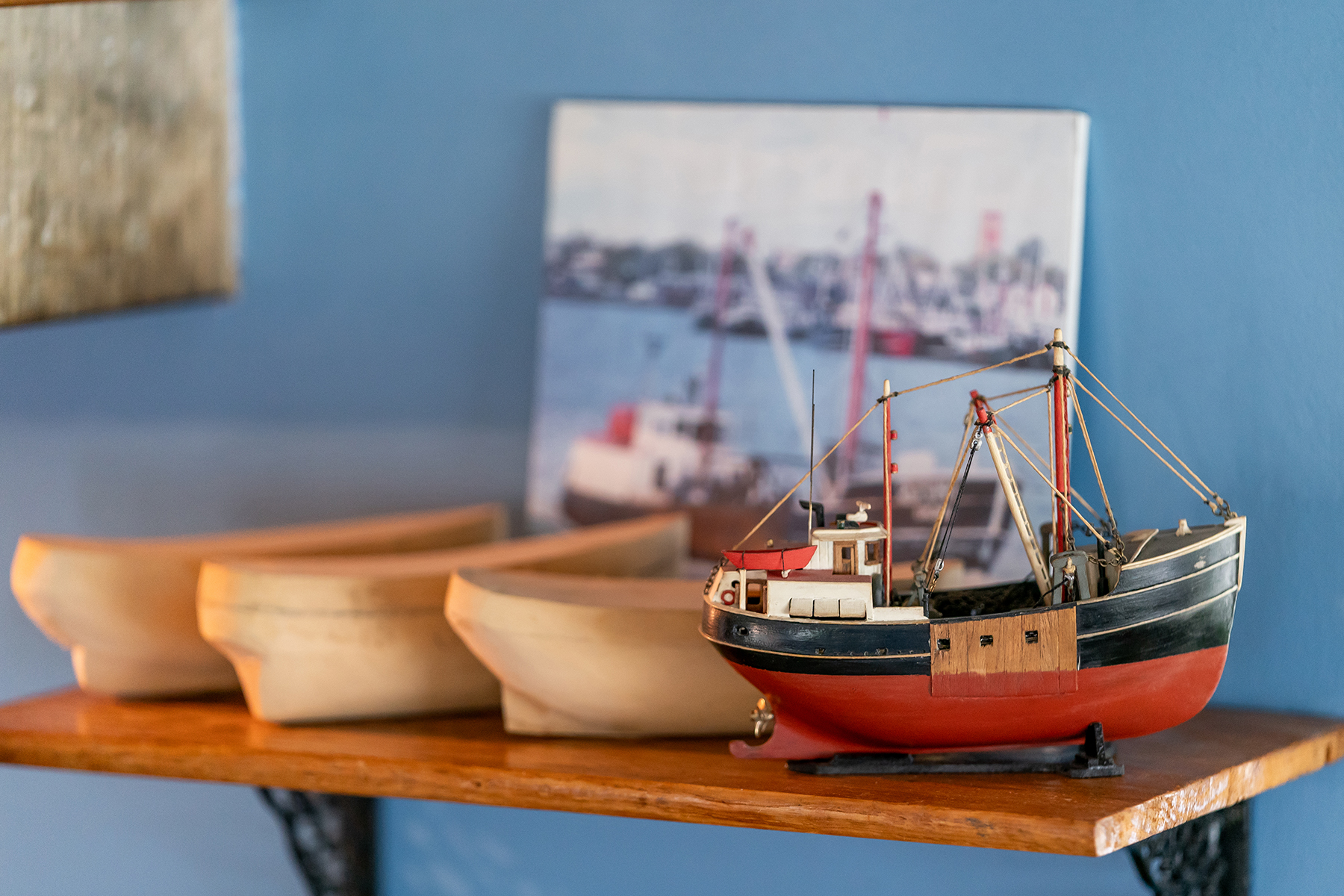
After making sketches and eyeing the boat, it’s now time to craft the hull. There are three hull construction options: a solid hull, a plank-on-bulkhead (P.O.B.), and a plank-on-frame (P.O.F.).
The solid hull is a rectangular block of wood. The wood is generally made of basswood or balsa wood. A modeler would carve outside the hull, then use a dremel tool to hollow out the inside. Once it is hollow, stringers are laid down in longitudinal forms in line with the keel, from stern to the bow. After that the deck beams and short beams are laid, side to side.
Instead of starting with a solid base for the hull, the plank-on-bulkheads method begins with the bulkheads. Bulkheads are vertical interior surfaces and are assembled perpendicular to the keel from the center of the keel first. In choosing this method it is crucial that the modeler pays close attention to the keel. It’s important that the keel is straight and not warped. A warped keel creates misaligned bulkheads which can ruin the model’s foundation.
Plank-on-frames method mimics the traditional building process of a real life-sized boat. Scaled down measurements are used to create the frame. Then carefully measured thin strips of wood are individually layered one after another, curving along the frame. Each plank is nailed down to the frame or either glued in between gap spaces. The finishing touch then is to trim jagged wood pieces and to sand down everything to a smooth finish.
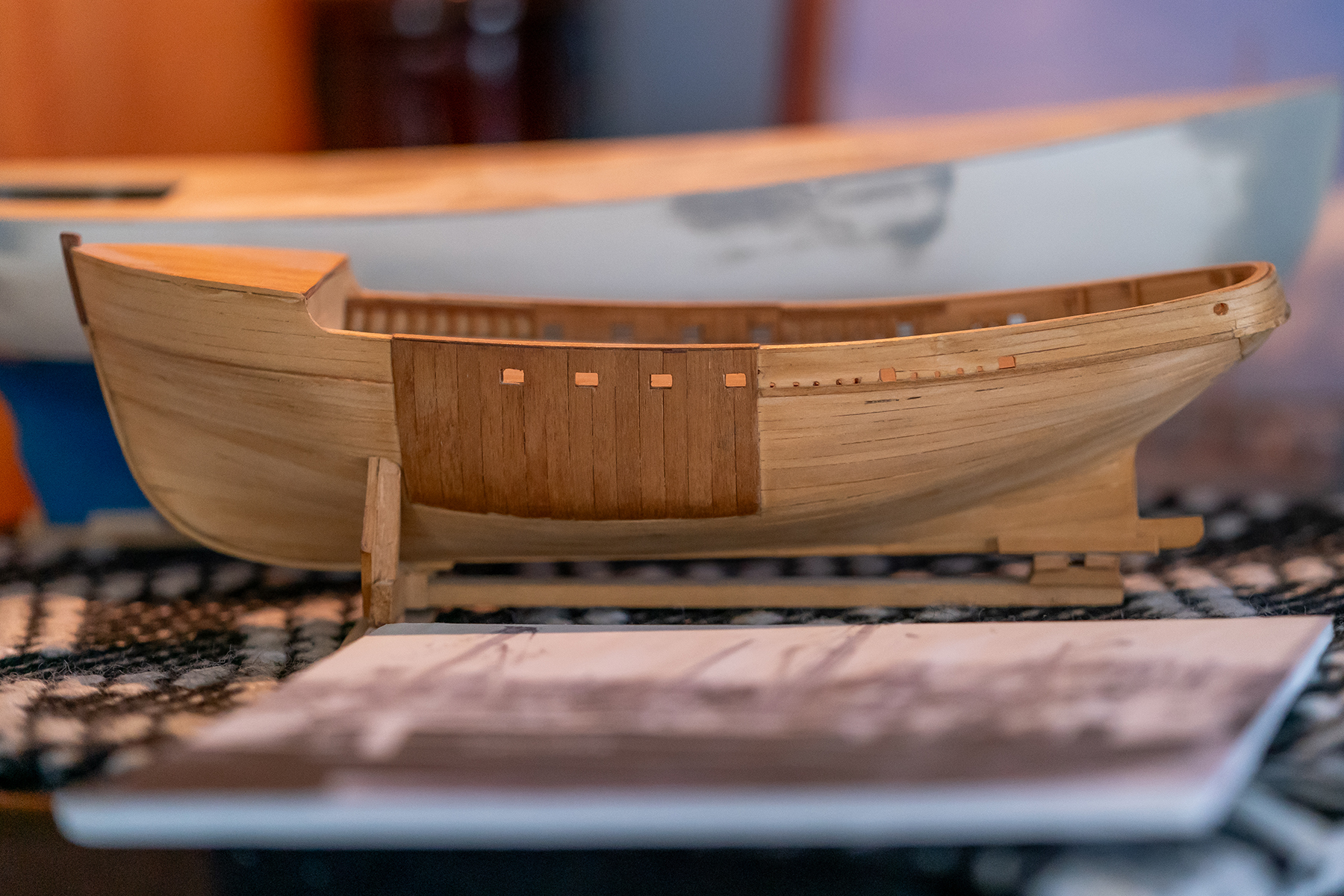
There is a common mindset amongst modelers to keep in mind functionality of the boat. “You have to envision tiny fishermen using the model boat,” says Gifford. Because of this requirement, every piece of the boat is made with realistic materials as well. For example, the material used in the chains and anchor should be real metal not plastic. The right raw materials for a model can be found through online vendors, such K&S Precision Metals, Peter’s Model Ship Supplies, and Harbor Models.
The tools that are most commonly used include X-Acto knives, dremels, carpenter squares, sanding blocks and jigsaws. One’s level of expertise dictates how many and what tools a modeler would use.
Model boat building is a masterful craft. Its process cannot be rushed nor can one take shortcuts. It can take months or even years for completion of just one model. Any amount of rushing leads to mistakes, warping, wrong measurements. “If the boat isn’t coming out right, you have to step away from it,” Gifford says.
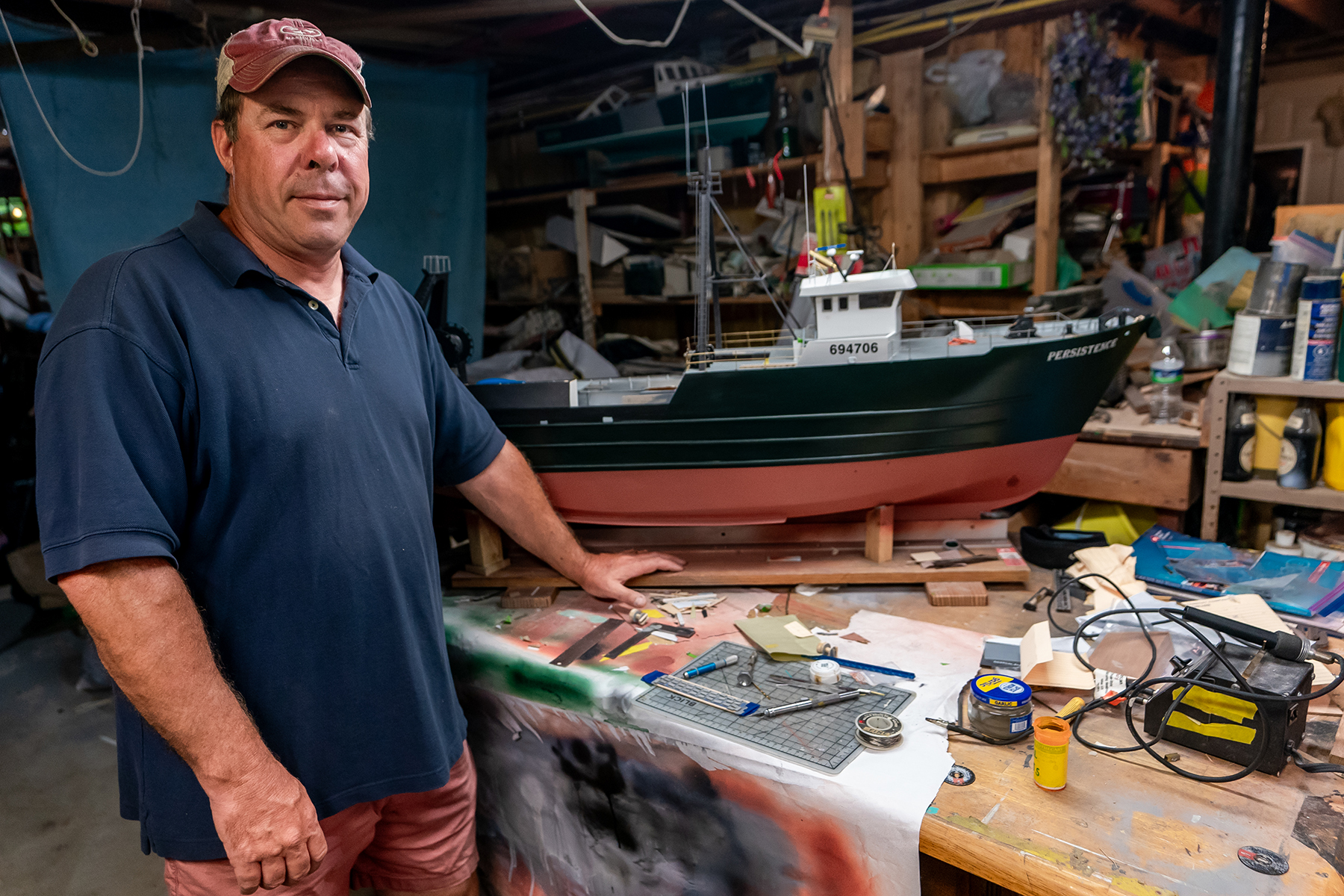
The right environment can play a crucial role in maintaining the creative muse. Every modeler has their own unique setup that fits their personality. Gifford likes to wake early in the morning, settle in his workshop, and begin a project with music softly playing in the background. In contrast, Curtis prefers to set his workshop outside, whether that be on a boat deck or sitting at the galley tables. The beauty of the hobby bears the freedom of choosing where to build.
As long as there are fishermen and marine enthusiasts like Curtis and Gifford, the art of model boat building will forever sail onward.
Where to Find Model Boats
The South Coast boasts many model boat builders from the past. One famous builder was a New Bedford native named Edgar B. Hammond. Long-deceased now, Edgar and a team of builders built the world’s largest half-scale boat model called the Whaling Bark Lagoda found at the New Bedford Whaling Museum.
Interested individuals can also find two of Bruce Gifford’s models on display at the Whaling Museum. These boats are the Concordia, a scalloper that was infamously chased by a Canadian Navy destroyer due to allegations of illegal fishing in Canadian waters. And the Nobska, a groundfish dragger, which is a fishing boat that drags hefty nets along the ocean floor scooping up fish for public consumption.
The art of crafting model boats by hand has dwindled in numbers over the years. However, small groups of individuals still hold genuine curiosity about model boats and their nautical beauty. The New Bedford Fishing Heritage Center is one of the educational havens for such individuals, and has held modeling classes hosted by Bruce Gifford and Alan Curtis themselves. Here both captains provide demonstrations of their building process and teach about the history of model boats.
whalingmuseum.org
fishingheritagecenter.org