
Story by Scott Lajoie
Wood Block Print Art by Aurora Goodland
The Buzzards Bay Watershed is home to thousands of species of mammals, birds, reptiles, and amphibians, all of which comprise a complex ecosystem. Here are the stories of six species with significant influence in their natural environment and the local people who have studied or advocated for them.
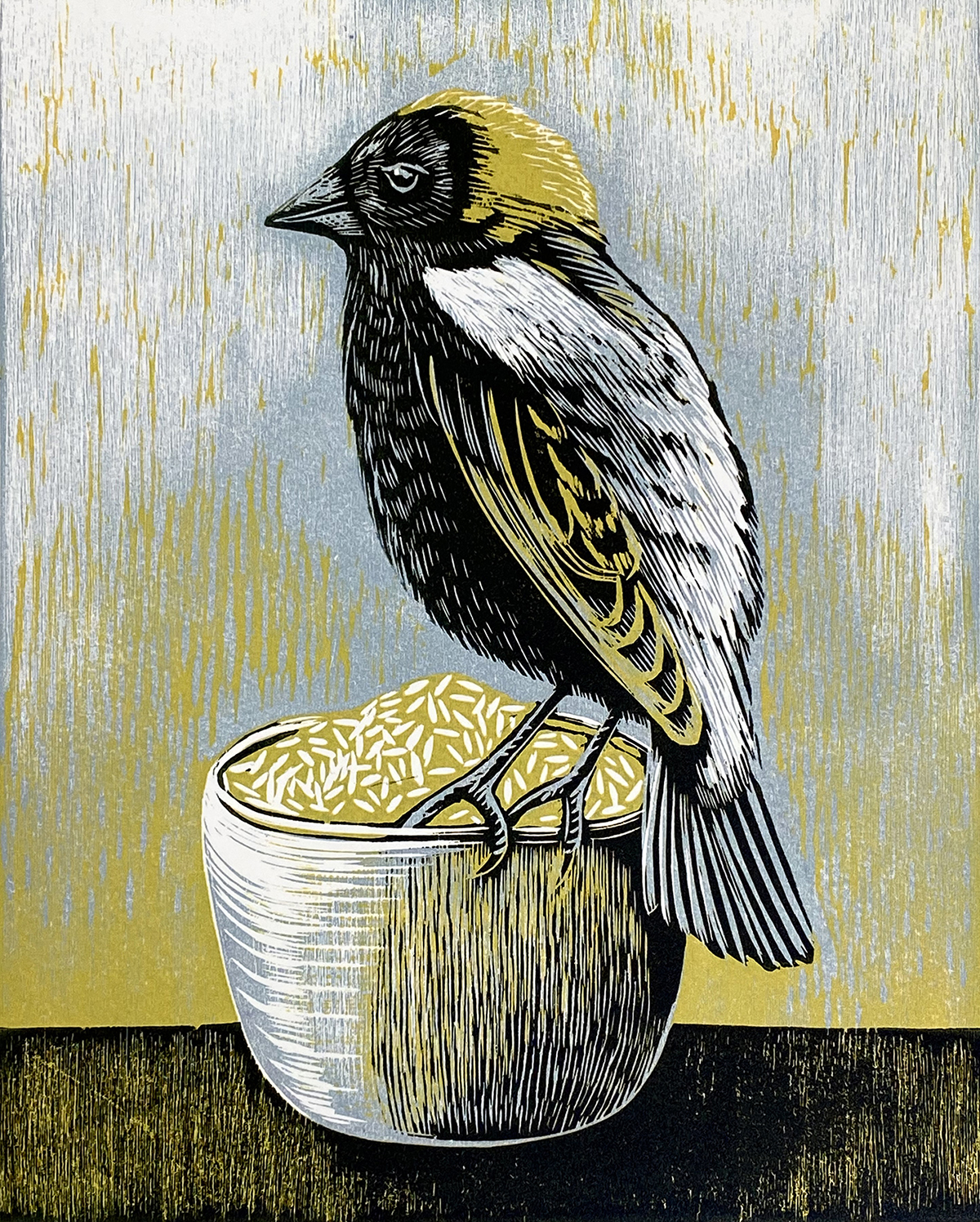
Bobolink
Financial pressures force New England’s working farmers to mow their hayfields earlier and more frequently. But several bird species, such as the charismatic bobolink (Dolichonyx oryzivorus), depend on the cover of tall grasses on open acres of fields for their summertime breeding. Adam Yorks, stewardship director of the Sakonnet Preservation Association, knows this all too well; he raises sheep on his farm in Little Compton and has encountered many bobolinks in the area.
The Bobolink Project, an initiative by the Massachusetts, New Hampshire, and Rhode Island Audubon chapters, uses donated funds to “provide financial assistance” to participating farmers who agree to modify their mowing schedules so that “grassland nesting birds can successfully raise their young.”
This innovative work provides a new way to connect people who are willing to make financial donations to sustain our wildlife and rural heritage with farmers who are willing to help, but who also face stark economic realities, according to the Project.
Some work is being done independently of the Project, too. A group of Little Compton landowners manage their grasslands to accommodate returning bobolinks by delaying any mowing until the end of July.
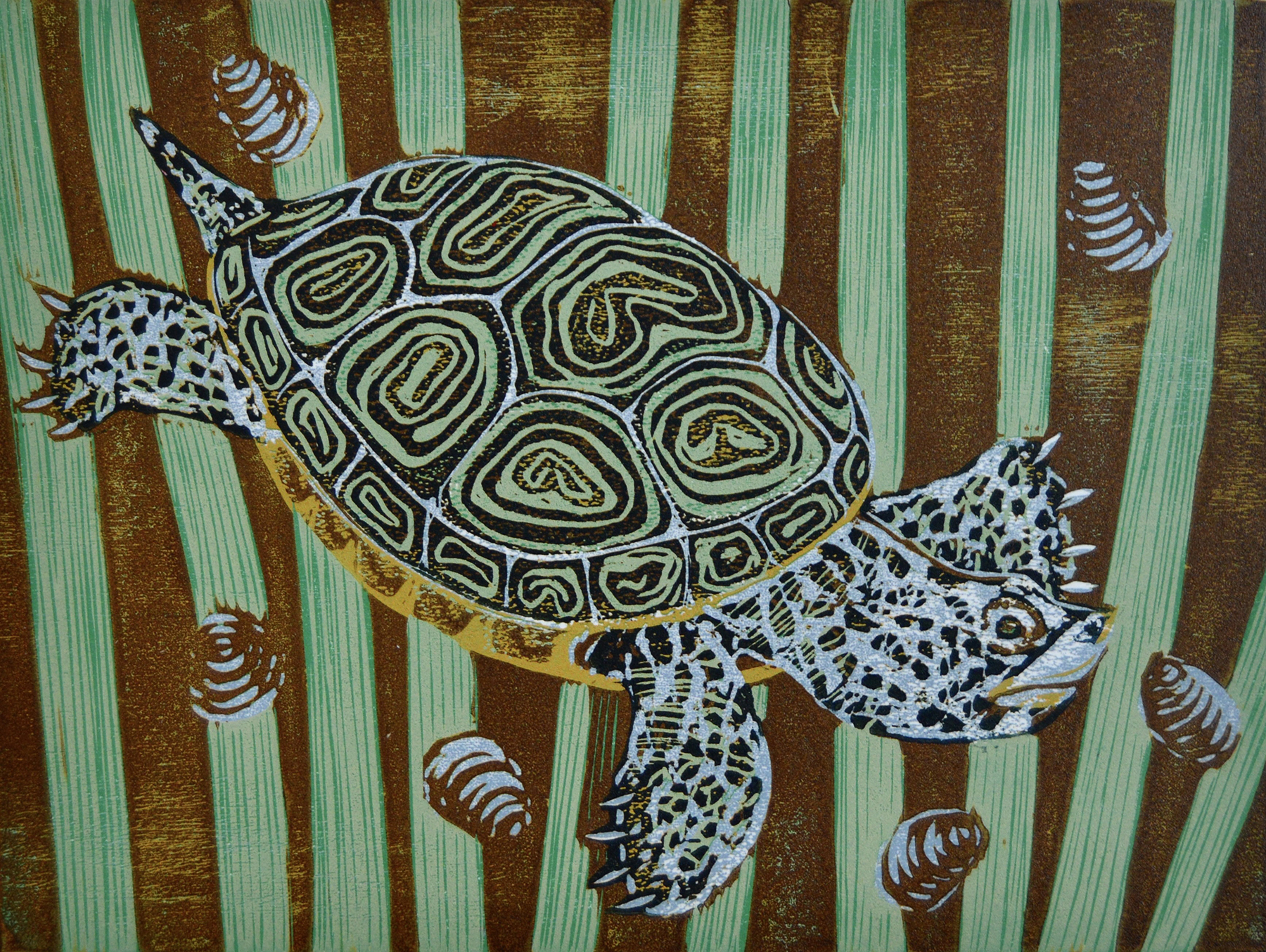
Diamondback Terrapin
The diamondback terrapin (Malaclemys terrapin) is the only turtle species in the Northeast that specializes in the salt marsh, adapted to the brackish waters, living in the daily cycles of the tides, preying on the snails that eat the salt marsh plants themselves. For years, scientists have studied the species on Cape Cod, specifically Wellfleet. But up until recently, the state didn’t know much about how prevalent they were in Buzzards Bay.
Then they started a long-term study from the Rhode Island border to the Cape Cod Canal. “We use boat-based visual surveys, counting turtles and clusters of turtles,” says Jon Regosin, former MassWildlife deputy director who has recently gone back into the field. “They are beautiful turtles, and I am fascinated by their ability to adapt and navigate the salt marshes as well as they do,” he says.
The research is a partnership between MassWildlife, Zoo New England, and Dr. Lucas Griffin’s lab at the University of South Florida, of which two local students are affiliated: Emma Keene-Reinhard of Fall River and Ally Jones of Yarmouth. The two hope to be out on kayaks this summer capturing, measuring, marking, and tagging for acoustic telemetry to continue to understand the animals’ paths throughout the marsh and river network.

Eastern Red-backed Salamander
Even though the eastern red-backed salamander (Plethodon cinereus) is prolific here in the Northeast, studying them is a great way for biology students to get a feel for scientific field research. And surprise! As recently as 2018, it was discovered that there were traces of biofluorescence on their tails.
When Bridgewater State University Professor Caitlin Fisher-Reid was younger, she loved searching for salamanders under felled logs near her Long Island home and while on vacation in the forests of New Hampshire. More than 20 years after she started grad school specializing in how new species form, she is working in her dream job.
In addition to her lecture duties and undergraduate research guidance, the Taunton resident runs a program focused on recent college graduates who may not have had access to research experiences while in college. Funding comes from the National Science Foundation’s Research and Mentoring for Postbaccalaureates in Biological Sciences initiative, which also seeks to “advance the goal of creating a competitive and highly representative science, technology, engineering and mathematics (STEM) workforce in the US.”
Beginning in 2024, the first group of participants worked as full-time research fellows studying salamanders ecology at sites across the eastern United States. Last year’s group studied survivorship; this year’s, body condition.
Climate change is also a component of the fellows’ research. They will work as part of the Salamander Population and Adaptation Research Collaboration Network, through which Fisher-Reid and other scientists study how salamanders respond to changing environmental conditions. Red-backed salamanders belong to a family of salamanders who lack lungs, an ancestral trait, thus they are entirely reliant on their permeable skin for respiration, which is susceptible to drying out. Thus, much of the ecology and behavior of the red-backed salamander is restricted by climatic and microclimatic variables, particularly moisture and temperature.
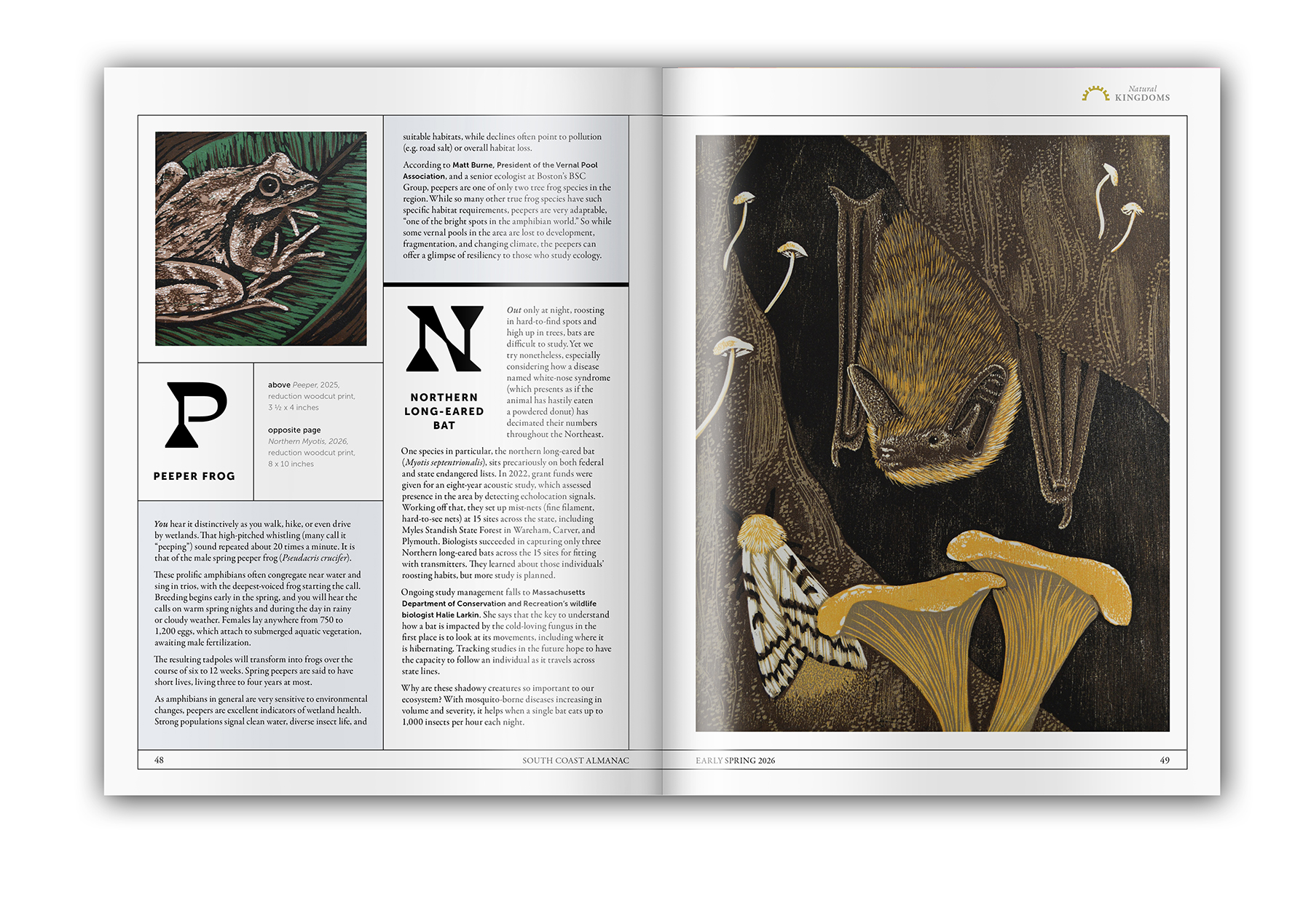
Peeper Frog
You hear it distinctively as you walk, hike, or even drive by wetlands. That high-pitched whistling (many call it “peeping”) sound repeated about 20 times a minute. It is that of the male spring peeper frog (Pseudacris crucifer).
These prolific amphibians often congregate near water and sing in trios, with the deepest-voiced frog starting the call. Breeding begins early in the spring, and you will hear the calls on warm spring nights and during the day in rainy or cloudy weather. Females lay anywhere from 750 to 1,200 eggs, which attach to submerged aquatic vegetation, awaiting male fertilization.
The resulting tadpoles will transform into frogs over the course of six to 12 weeks. Spring peepers are said to have short lives, living three to four years at most.
As amphibians in general are very sensitive to environmental changes, peepers are excellent indicators of wetland health. Strong populations signal clean water, diverse insect life, and suitable habitats, while declines often point to pollution (e.g. road salt) or overall habitat loss.
According to Matt Burne, President of the Vernal Pool Association, and a senior ecologist at Boston’s BSC Group, peepers are one of only two tree frog species in the region. While so many other true frog species have such specific habitat requirements, peepers are very adaptable, “one of the bright spots in the amphibian world.” So while some vernal pools in the area are lost to development, fragmentation, and changing climate, the peepers can offer a glimpse of resiliency to those who study ecology.
Northern Long-Eared Bat
Out only at night, roosting in hard-to-find spots and high up in trees, bats are difficult to study. Yet we try nonetheless, especially considering how a disease named white-nose syndrome (which presents as if the animal has hastily eaten a powdered donut) has decimated their numbers throughout the Northeast.
One species in particular, the northern long-eared bat (Myotis septentrionalis), sits precariously on both federal and state endangered lists. In 2022, grant funds were given for an eight-year acoustic study, which assessed presence in the area by detecting echolocation signals. Working off that, they set up mist-nets (fine filament, hard-to-see nets) at 15 sites across the state, including Myles Standish State Forest in Wareham, Carver, and Plymouth. Biologists succeeded in capturing only three Northern long-eared bats across the 15 sites for fitting with transmitters. They learned about those individuals’ roosting habits, but more study is planned.
Ongoing study management falls to Massachusetts Department of Conservation and Recreation’s wildlife biologist Halie Larkin. She says that the key to understand how a bat is impacted by the cold-loving fungus in the first place is to look at its movements, including where it is hibernating. Tracking studies in the future hope to have the capacity to follow an individual as it travels across state lines.
Why are these shadowy creatures so important to our ecosystem? With mosquito-borne diseases increasing in volume and severity, it helps when a single bat eats up to 1,000 insects per hour each night.
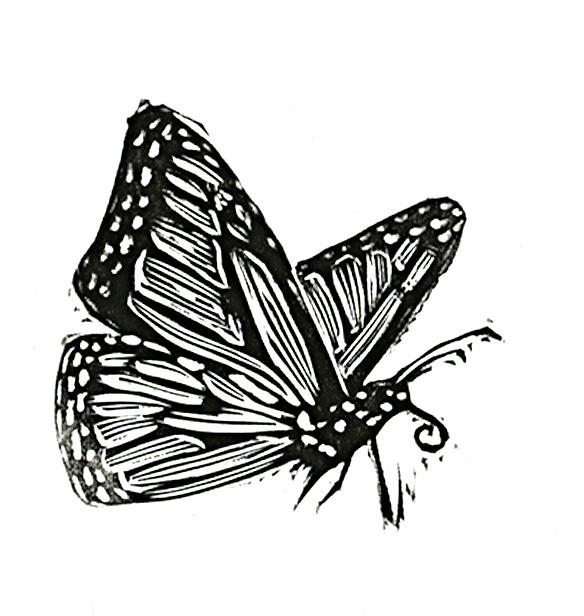
Monarch Butterfly
The monarch butterfly’s annual 3,000-mile fall migration from Canada through the US and down to Mexico is one of the longest known in the world. Monarchs can travel up to approximately 70 to 75 miles a day during this trek, according to tagging data (the longest single day flight was recorded at 265 miles). They will mate at the overwintering sites before dispersing to head back north in the spring.
But there is little known about how individuals forage so well in the face of constantly changing floral resources migratory routes. So UMass Dartmouth professor Robert Gegear did some testing.
Male and female migratory butterflies were consecutively trained to discriminate between colors and odors, then tested for their ability to simultaneously retain the information over a week. He discovered that monarch butterflies, as a migratory species, have better memory that enables them to search more efficiently for food. His findings were published in the journal Insects a few years ago.
These pollinators play a crucial role in the reproduction of many plants, and they are a food source for many other animals. Their populations also serve as one of the best “indicator species,” reflecting the broader health of the environment, particularly concerning habitat loss and pesticide use.
Due to first annual, then seasonal, counts by the North American Butterfly Association (NABA) running since 1975, The US Fish and Wildlife Service proposed in December 2024 to list Monarchs as threatened under the US Endangered Species Act. The National Fish and Wildlife Federation’s Monarch Butterfly and Pollinators Conservation Fund has developed sustainable and affordable supplies of native milkweed and nectar-producing plant seeds and seedlings that support habitat restoration efforts.
About Aurora Goodland
Based in Tiverton, Aurora is an artist specializing in woodblock printmaking. “Art and nature have always been my source of passion and peace, from painting in my grandparents’ garden as a child to majoring in environmental science and art at Simmons University," she says.
At the heart of her practice is an exploration of interconnection: the understanding that no species exists in isolation, each playing a role in shaping ecosystems and, in turn, our shared experience as a part of the natural world. By centering her work around native species, she invites you to develop a deeper awareness of the ecosystems we are an intimate part of. This will also be the focus of her new monthly art mail club launching later this spring.
Connect with Aurora about her work, commissions, printmaking lessons, and art mail club through her:
website auroragoodland.com
email [email protected]
instagram @auroragoodland.art
You may also see her work at Harmony Winters’ shop in Westport.
