
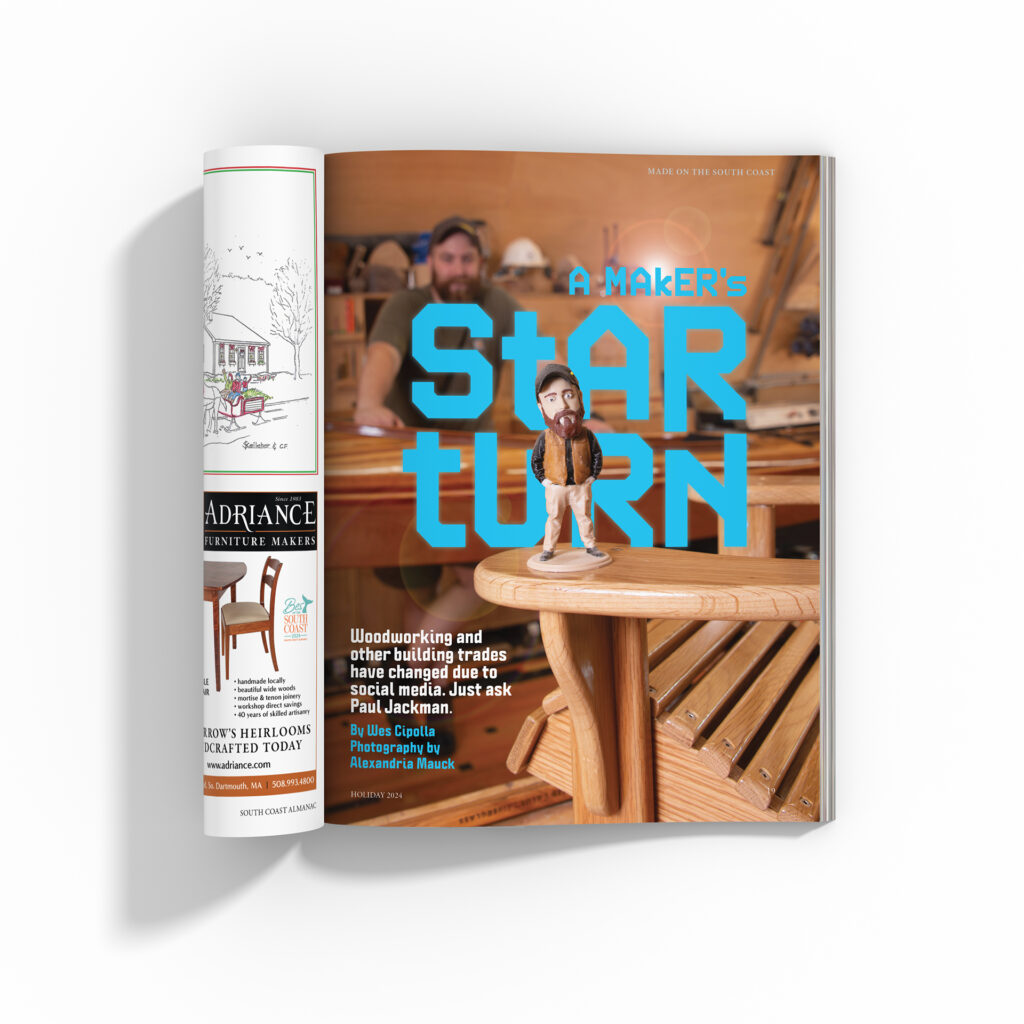
By Wes Cipolla | Photography by Alexandria Mauck
What does Paul Jackman do for a living? It depends.
When people older than Jackman, 33, ask about his occupation, he tells them he’s a woodworker. When people younger than him ask, he tells them he’s a YouTuber.
Both answers are true. In his barn loft workshop overlooking Onset Bay, Jackman turns out handmade wooden crafts from the practical to the whimsical. Such creations as a full-size teardrop trailer, a working electric guitar, and a version of the leg lamp from A Christmas Story made to resemble his own leg are viewed by millions on his YouTube channel, Jackman Works. Jackman Works has over 393,000 YouTube subscribers, 83,000 followers on Facebook, 143,000 followers on Instagram, and an eight-episode Netflix series. Jackman has built a brand for himself by doing a timeless craft in an ultramodern way.
“It’s exciting to have a bigger audience to show your work to more people,” he says.
I visit Jackman’s Buzzards Bay workshop on a sunny September afternoon. It’s located behind his home, where he lives with his wife Kristen and four cats — Cooper, Piper, Teddy, and Sarah. (For Sarah, he made a three-foot-tall cat house shaped like an S.)
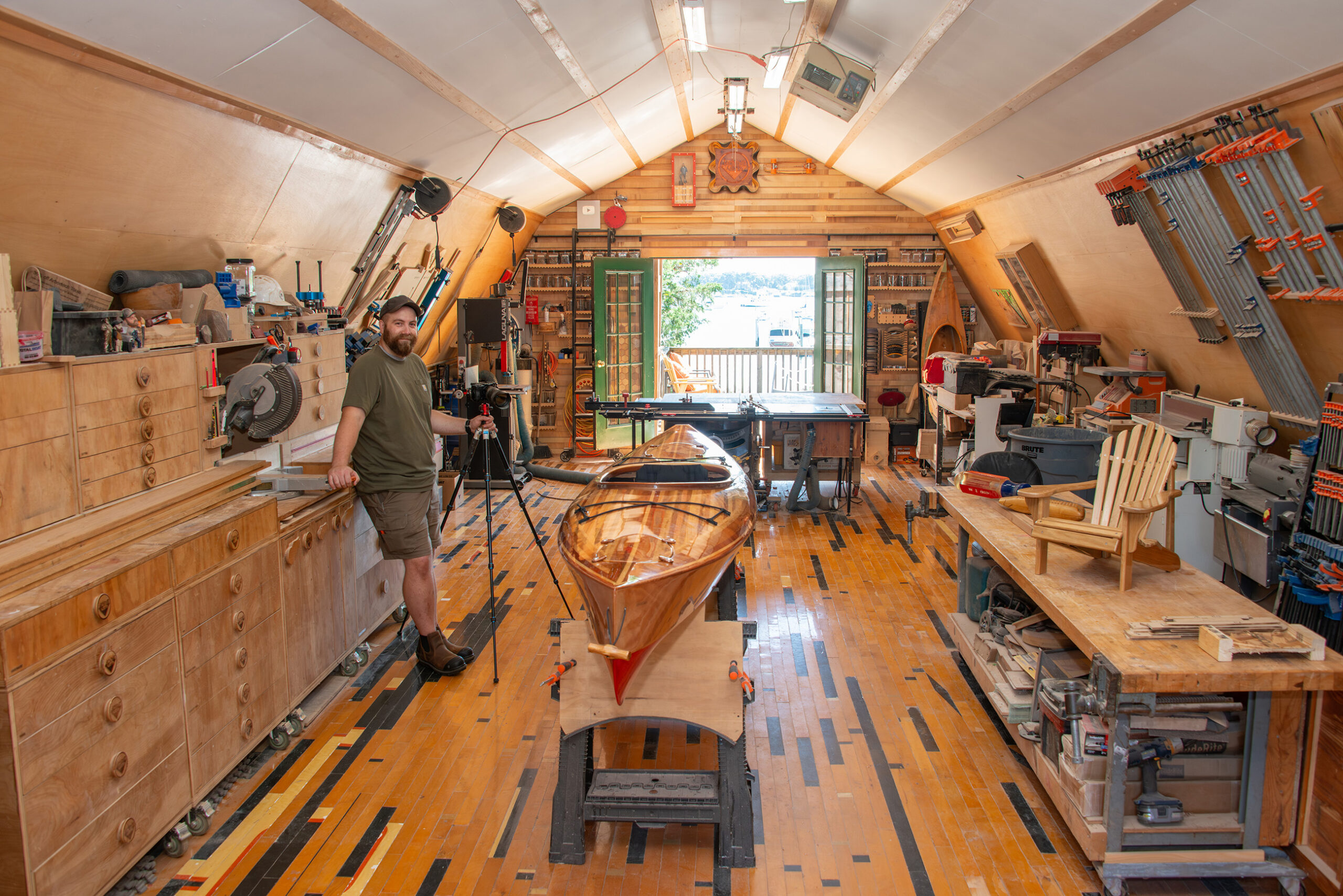
The rough-shingled barn looks at least 100 years older than it is. It was built in the ‘90s by Kevin McFadden, Jackman’s carpentry teacher at Upper Cape Cod Regional Technical School. “He’s been a really good role model for me,” Jackman says. “Really showing hard work and how it pays off, and some unorthodox techniques and thinking outside the box.”
McFadden uses the first floor of the barn and rents the second to Jackman. The 1,000-square-foot workspace has no air conditioning, save for the wind. “You just sweat it out,” Jackman says, “it’s not too bad.”
At the top of the stairs leading up to the workshop, there is a dusty, enigmatic portrait of a young woman, a relic from the merchant seaman who once owned the property. “The Spanish Lady,” as the painting is known, once hung high above Jackman as he worked. Some of
his YouTube commenters were unnerved. “She was always looking down on me, it was kind of creepy,” Jackman said. “So I moved her to the staircase, which is just as creepy.”
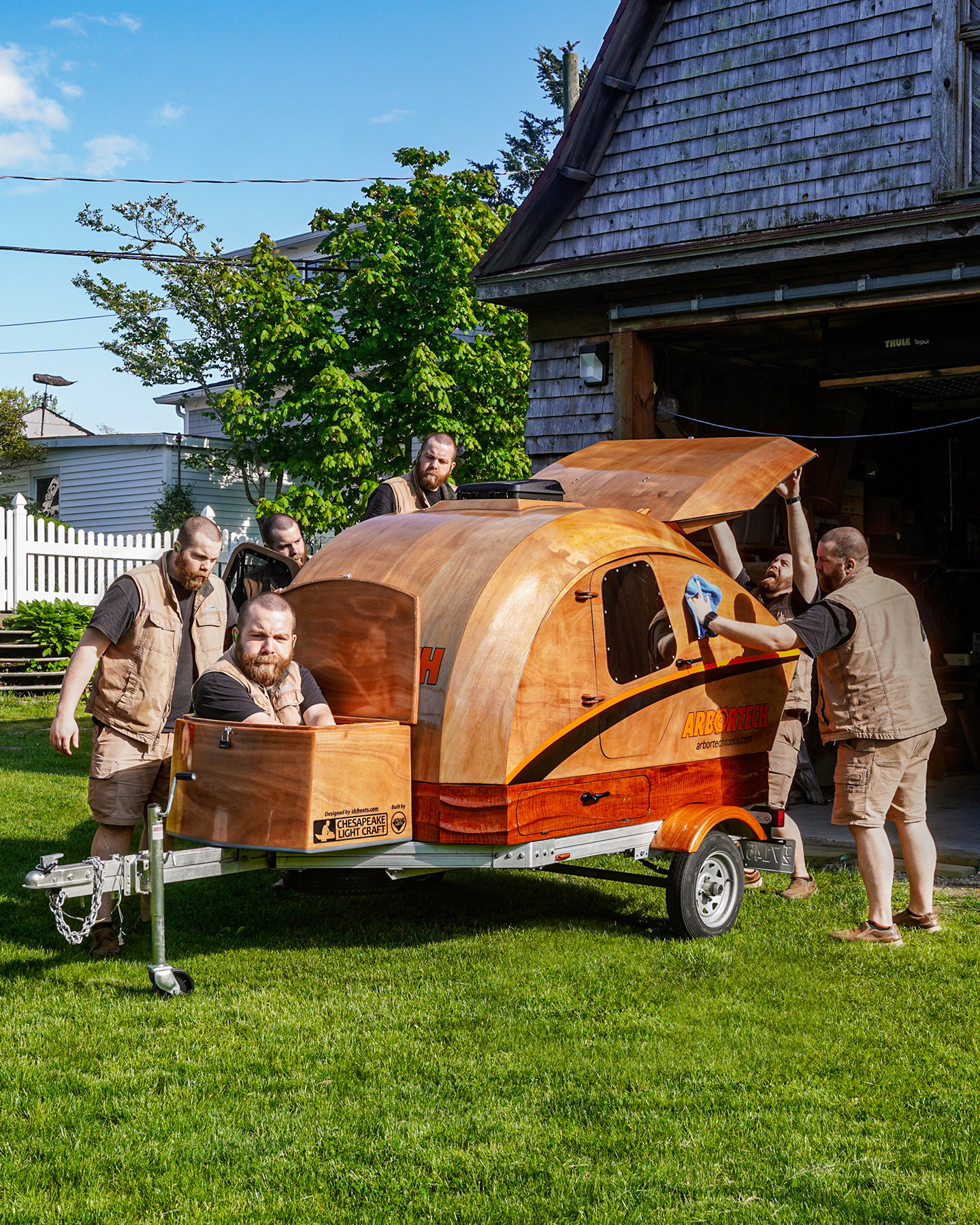
Across from “The Spanish Lady” is a work of Jackman’s own: 13 photos of himself, edited around a workbench in a parody of Da Vinci’s Last Supper.
The workshop itself is bathed in sunlight from Onset Bay. Being close to the water is inspirational to Jackman, and he enjoys the close-knit quaintness of Onset Village. He described it as having the beauty and charm of a small town with all the conveniences of city life. “Harbor Freight’s a five-minute drive away,” he says, “but you wouldn’t know it.”
Outside on the balcony are two Adirondack chairs Jackman made, one adult-sized and one child-sized. He had heard people’s complaints about Adirondack chairs being hard to sit in and get out of, so he decided to make his own, an upright Adirondack chair that you can sit at the dinner table with. Selling templates so one can build those chairs on his/her own is a big part of his business.
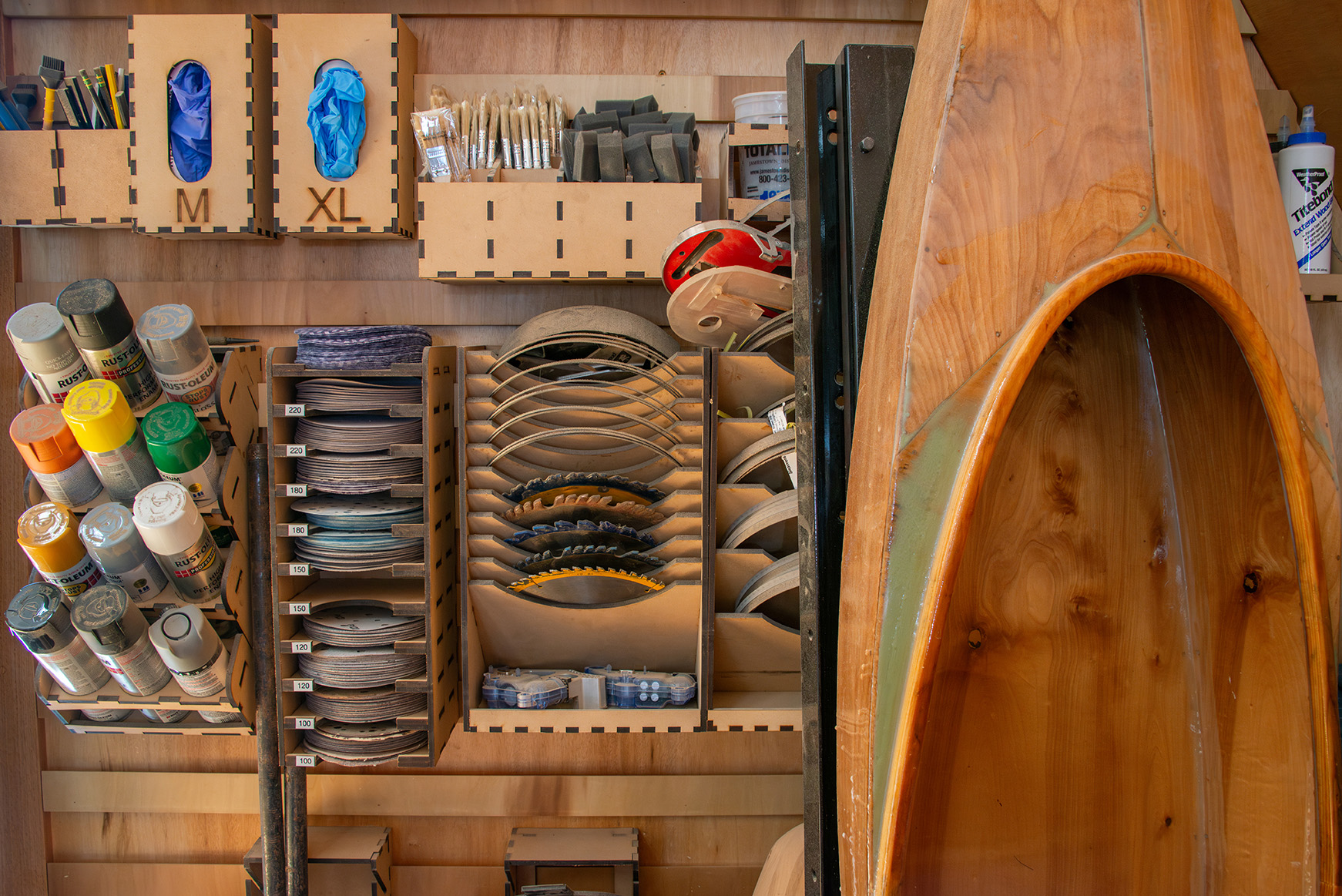
A sign in the workshop announces that Jackman is “Employee of the Month, June 2009-present.” When Jackman first moved into the workshop in 2020, the loft was nothing but studs and insulation. Jackman completely customized the space, covering the ceiling and walls in plywood. The floor came from a Baltimore school’s basketball court. Jackman built the cabinets that hold his hundreds of tools himself, complete with Jackman Works logos affixed to the knobs. Other cabinets were custom-built to fit the angle of the barn’s gambrel roof.
Jackman likes wood because of its flexibility, ease and variety of colors and grains. “It’s like painting a canvas,” he says.
At the center of the workshop is Jackman’s latest project, a sleek 14-foot kayak (“A pretty big boy,” by Jackman’s standards.) Built for a YouTube video, the kayak is based on a kit by the Chesapeake Light Craft company. It came with wooden strips to build with, but Jackman decided to make his own out of reclaimed pallet wood. “I wanted it to be unique,” he says.
The wood had to be smoothed down, cut specifically to fit together, covered in fiberglass, varnished and painted. He estimated that the whole process took two to three months and 10 pallets of wood. The build, which he plans to use on the water, was inspired by the boatbuilder who once lived in his house.
“I don’t think he ever finished any,” he said. “When I moved in here, I was like, ‘I have to build a boat in here.’ The romantic idea of finally building a boat up here and launching it in the bay.”
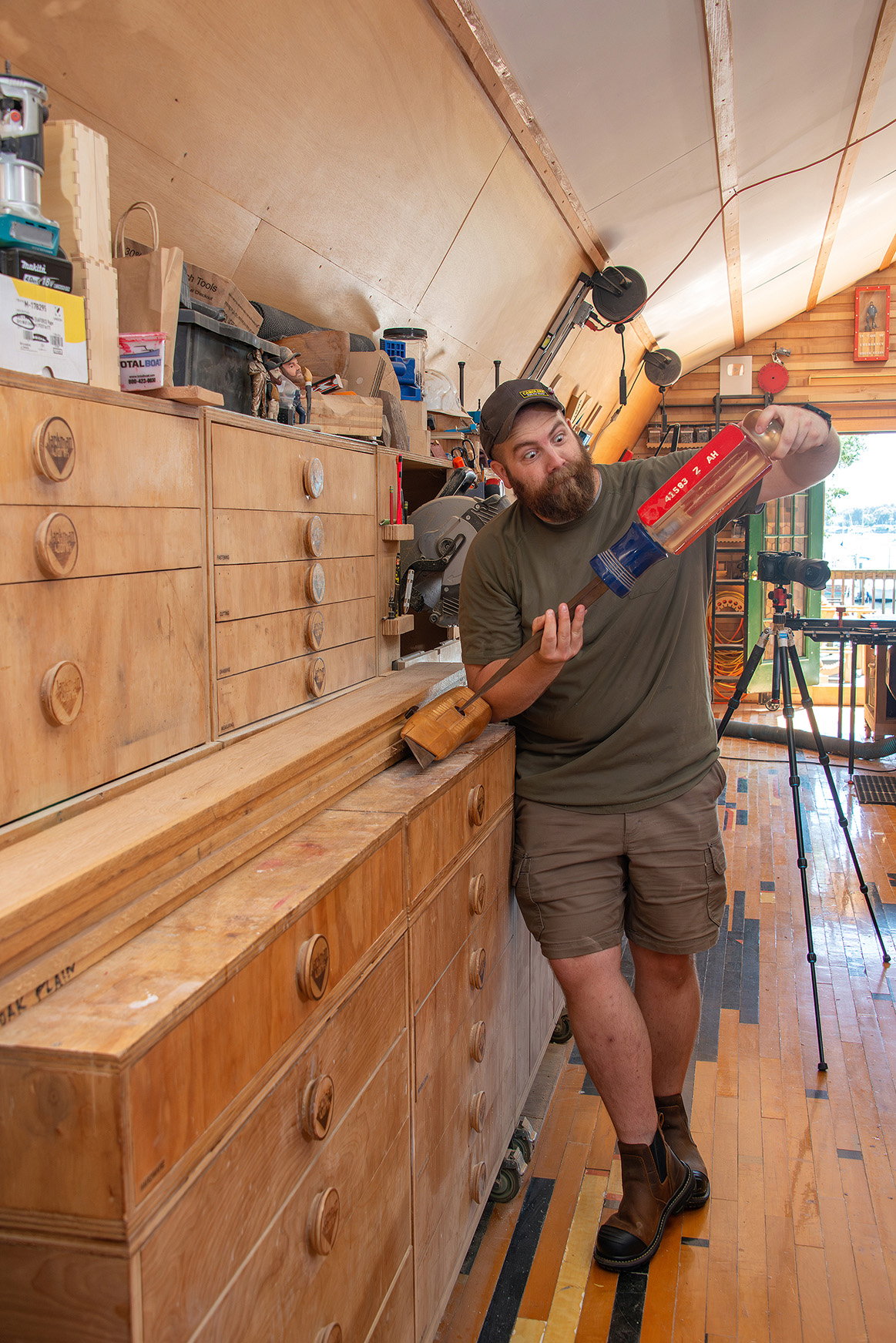
Jackman also recently finished a 20-pound, three-foot-long screwdriver made out of epoxy. A friend of his forged the metal shank and tip. (“I have all of these maker friends that have all these crazy talents like this,” he says.)
The screwdriver was built to be big enough for the screw of a giant wooden boxcutter he made for YouTube. Jackman has always had a love for creating gigantic versions of everyday objects such as PEZ dispensers and LEGO minifigures.
“I find it very humorous,” he says, “but also from an artistic perspective, it’s very intriguing to see things at a scale they’re not supposed to be at.”
Jackman’s father was a cook, not a carpenter. Nevertheless, he had a few tools that he let his son use. “I just kind of naturally liked making stuff and building stuff and taking things apart and then putting things back together,” he says.
Jackman got his start building skateboard ramps when he lived on Otis Air Force Base. “All of the kids in the neighborhood would come on our driveway and play on the ramps,” he says. “That’s how it all started.”
At Upper Cape Tech, McFadden, or “Mr. Mack,” as Jackman affectionately called him, became his mentor. “He’s a very understanding person,” Jackman said. “He’s the type of guy that if you show an initiative, he’ll really take you under his wing and give you a lot of effort.”
After graduating in 2009, Jackman got an engineering degree from Syracuse University and a job as an estimator for a big construction company. “I didn’t mind it,” he said. “It was a desk job, though, so it got a little boring at times. I still had the woodworking bug in the back of my head.”
He started watching woodworking videos on YouTube, including ones by Jimmy DiResta, a maker based in upstate New York who would become Jackman’s friend and frequent collaborator. Jackman thought these videos were “the coolest thing in the world” and decided he could make them too, so he bought a camera. He knew nothing about video production, so he learned by doing, spending nights and weekends in his basement “just playing around.”
Soon, he discovered the “limitless” possibilities of the internet. On a shelf in his workshop are two sawdust-covered bobbleheads of himself, one made by a YouTube ad sponsor and another made by a fan (Jackman Works has fans in places as far-flung as Europe and South America). As his YouTube fame has grown, more and more of Jackman’s builds are what he thinks will get him views. He said he knows what to build to get even more views and subscribers, but would rather spend time making what he wants to make.
“I try to straddle that line very carefully with building what I want to do and building what I think will be viewed and received well,” he says.
His income is primarily from sponsorship and ad revenue, and he is at the mercy of ever-changing YouTube algorithms which can boost or hide his videos. He wonders how he can “follow this formula the internet wants” while also being an artist.
“You don’t get a weekly paycheck,” he says. “You’re just kind of at the whims of what sponsors come by.”
When it comes to his success, Jackman is reluctant to call himself “internet famous.” “It’s a weird thing to think about,” he says.
In 2016, the Jackman Works channel became successful enough to become a full-time job. That same year, he married Kristen. Kristen joining the Coast Guard was what allowed him to experiment with YouTube, and as luck would have it, after living in Washington, D.C., she was stationed at Joint Base Cape Cod.
In 2018, Jackman posted one of his projects on Reddit, and a TV producer happened to see it. The producer contacted Jackman, who told her about his fellow makers. She saw a photo of Jackman, DiResta and others in a giant Adirondack chair that Jackman had built to celebrate him getting 100,000 YouTube subscribers. The makers in the photo became the stars of the 2022 Netflix series “Making Fun,” in which they build fanciful inventions based on children’s ideas.
At first, Jackman was “apprehensive” because he no longer had total creative control over his image. He describes the Jackman Works character as being “equally sarcastic and tongue-in-cheek” as the real Paul Jackman. Would Netflix change his persona? “We got to be ourselves,” he says, “which was really nice.”
Jackman considered the final product, an unscripted series with the same showrunner as “Duck Dynasty,” to be better than he expected.
“Seeing your face up on Netflix is a very foreign thing,” he said. “It’s very legitimizing, too, to what you’re doing. As much as getting millions of views on YouTube or whatever makes you feel good, seeing your face on Netflix is something else.”
Find out what Jackman's up to today: jackmanworks.com

We post past articles on our website regularly. If you would like to get the magazine, go here to subscribe.
