
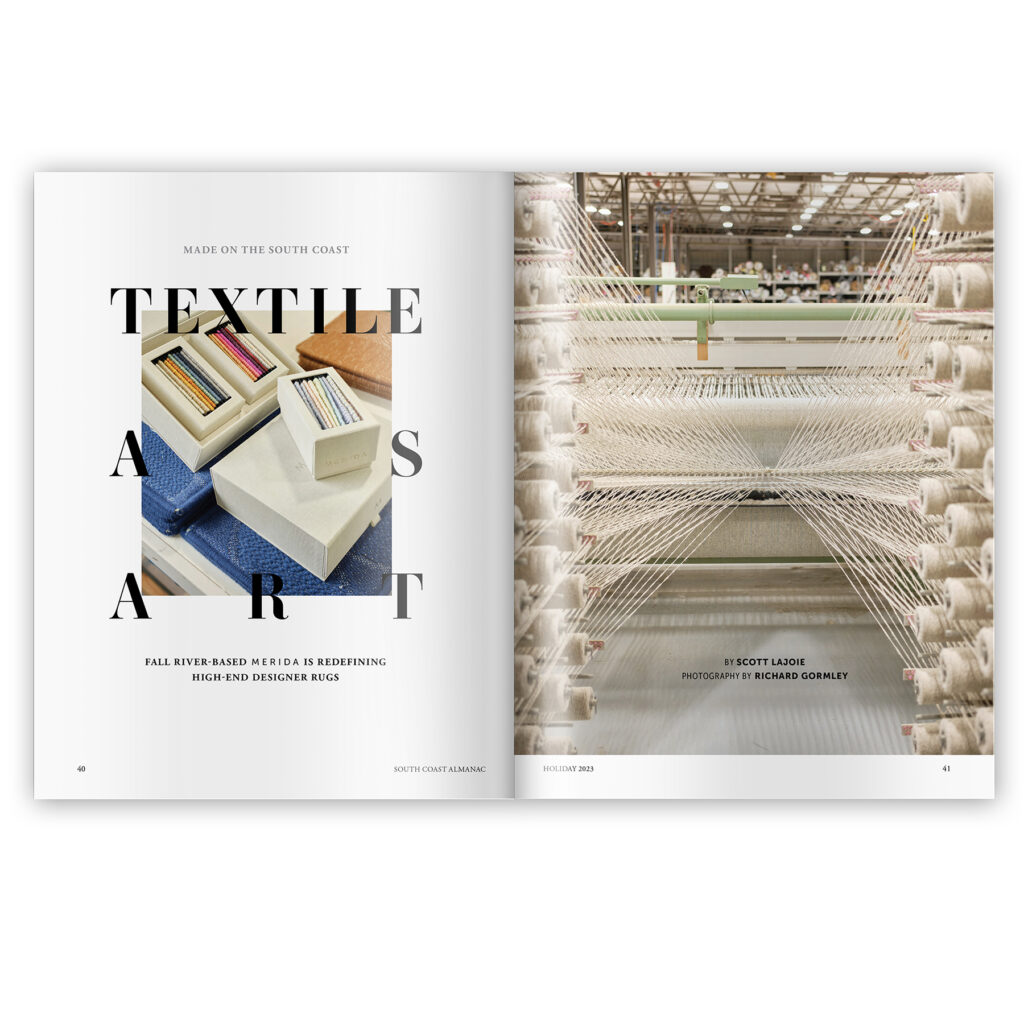
MADE ON THE SOUTH COAST
Fall River-based Merida is redefining high-end designer rugs
By Scott Lajoie | Photography by Richard Gormley
Fall River was once the textile production capital of America. At a point in the early 1900s, more than 100 mills produced a dizzying variety of textiles for clothing and home goods that were shipped and sold throughout the world. The production levels and overall talent pool of craftsmanship were heralded. The city boomed.
The heyday is long gone of course, but there are still a few vestiges of that industrial history that continue the tradition to this day.
Rug company Merida is one example. It was enjoying much success in the Spindle City in the latter part of the 20th Century, after relocating here from upstate New York. Merida had for much of the 1980s and 1990s been importing sisal, processed from a plant native to Mexico, and making durable, yet elegant rugs from the naturally grown material. The company had cornered the woven mat market through decades of effort to construct high-quality products while standing by its sustainability credo.
But when current owner and CEO Catherine Connolly came onboard in the 2000s, she sensed a seismic shift looming. Higher quality sisal rugs were emerging from Chinese workshops and being sold at lower price points. Connolly knew the company would have to move into the realm of wool rugs. But with wool rugs also being sold throughout the world in mass quantities, Merida would have to take a different tack. So they abandoned their wholesale model and marketed directly to designers. Connolly also named Sylvie Johnson, a Sengalese textile artist based in Paris, known internationally for her eye for design, as its artistic director.
The company transformed from a manufacturer to an artisan workshop making sought after one-of-a-kind rugs from British and New Zealand wool that are sent to the state of Georgia to be dyed, then woven and finished here.
The factory is located not in an old mill building, but in a rather nondescript converted warehouse in the industrial park. The floor is gigantic, with a number of looms to produce rugs of varying weave complexities. There are jacquard and dobby looms. Some are programmed by a computer; others follow an old-fashioned punch card for instruction.
The foundation of a rug hangs vertically off to the side of the floor and a robotic tufting machine fires away at areas of the rug to give it a cut pile look. When any of them are running, their paired human craftsperson is found working side by side with his/her robotic counterpart.
At least a third of the site’s floor space is taken up by a more than thousand square foot table, where Merida staff can put finishing touches by hand on a large rug.
But what stands out is the volumes of yarn. Merida boasts perhaps the largest yarn libraries in the country. They are strung into the looms from rolling stacks of spindles. When the looms are running, it is a sight to see them all spinning furiously. When the warp yarns have to be changed out, the restringing of a loom can take days.
In the Fall River facility, the design staff-overseen by Johnson who meets with them in person or over Zoom from her Paris offices-is hard at work coming up with designs for future collections, all of which are made into reality through computer-aided design (CAD). But they take a break from their computers and often work side-by-side with the craftspeople on the floor and see their designs come to life.
Last year’s collection was based on Arte Povera, one of the most significant and influential avant-garde movements to emerge in Southern Europe in the late 1960s. This year’s inspiration has been named Land Art. Each year, Merida comes out with 36 pieces in each collection. Designers are already finalizing designs for next year’s collection and the constructing of the rugs should begin this fall.
Sometime next year, these unique rugs will adorn lavish residences as well as the foyers and rooms of commercial spaces all over the world.
We post past articles on our website regularly. If you would like to get the magazine, go here to subscribe.